
How to: Letter of Agreement / Local Operational Procedures
Introduction
In real world aviation as well as on VATSIM accurate coordination between adjacent sectors, units, and control centres is essential. For this purpose, Letters of Agreement (LoAs) and Local Operating Procedures (LoPs) are foundational documents that define who does what, where, and how.
What are LoAs and LoPs?
Letters of Agreement (LoAs):
LoAs are formal documents that define agreed-upon coordination procedures between two or more ATC units. These often specify:
-
coordination points (where control is transferred)
-
level restrictions
-
special procedures
-
delegation of responsibilities
LoAs are critical when aircraft cross sector boundaries or change control between units (e.g., between two ACC sectors or between an ACC and a UAC). They essentially tell controllers “here is how we handoff traffic between us” and what conditions apply at each coordination point.
Local Operating Procedures (LoPs):
LoPs are internal operational rules within a single unit (such as an ACC or UAC). They define how that unit manages traffic within its own airspace and how it applies LoA terms with adjacent units. These documents form the backbone of day-to-day ATC operations and ensure consistency and predictability across positions.
Why reading LoAs/LoPs matters
In approach- and center-enviroments, the flow of traffic is controlled not only by radar and flight plans, but also by pre-agreed conditions documented in LoAs and LoPs. For a S3/C1 controller, understanding these documents means you can:
-
Interpret coordination points correctly and know at exactly which fix/level a handoff should occur.
-
Apply transfer of control and release criteria, such as climbs, descents, or turns before/after a boundary.
-
Anticipate restrictions so that you issue clearances that comply with agreements and avoid unnecessary re-coordination.
-
Coordinate verbally only when required, freeing up bandwidth for traffic handling.
LoPs often include common traffic flows, traffic release levels, and other internal coordination rules that are not always explicitly part of LoAs, but which controllers must know when on frequency.
How to read an LoA/LoP effectivly
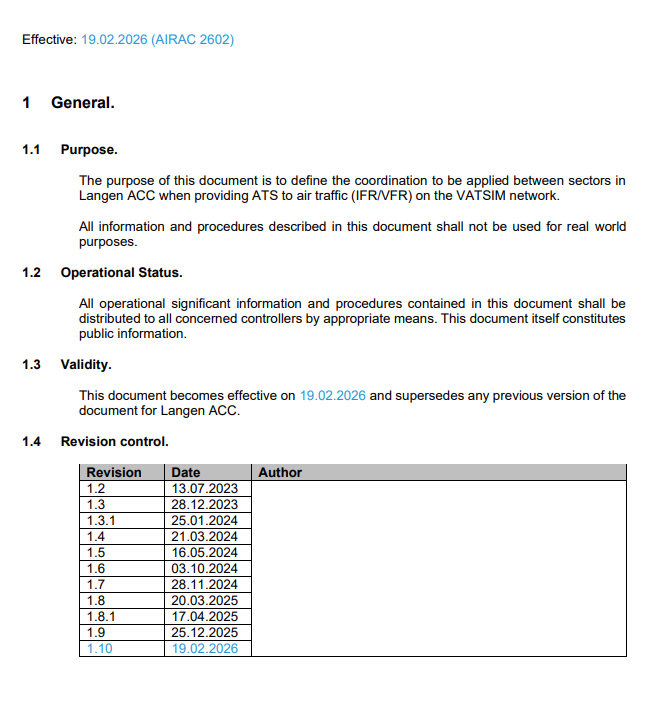
1) Start with the General Section
Almost every LoA/LoP begins with a Purpose and Validity section:
-
Purpose: tells you what the document covers—e.g., sector-to-sector coordination within an FIR.
-
Validity: tells you which AIRAC cycle the document applies to (e.g., AIRAC 2513).
-
Revision History: shows how recently and how often the document has been amended.
This gives context before diving into details.
Example: LoA General Part
2) Identify COPs, Sectors, Levels, Conditions
2.1) LoAs list Coordination Points (COPs) — typically waypoints, fixes, or geographical references.
COPs are reference points specified for the coordination of a flight profile. If defined in a LOA, the COP shall be used during verbal coordination to simplify identifying the flight for which the coordination is initiated.
Example: LoA Identifying CoPs

COP: BEMBO
2.2) LoAs list FROM Sector & TO Sector — shows the abbreviation of the involved sectors.
Example: LoA Identifying FROM & TO

FROM & TO: From sector Walda (WLD) to sector Dinkelsbühl (DKB)
2.3) LoAs list Level Allocation — shows the flight level at what the aircraft has to be handed off
Example: LoA Identifying Level Allocation

Level allocation: FL220
Little arrows (pointing upwards or downwards, e.g. ↓ or ↑) next to the FL indicate if the level allocation is ment as a climbing or descending movement to a specific FL. Any required crossing/speed restriction shall be added separately. At level means that the aircraft shall be in level flight on a published flight level and in accordance with east/west odd/even policy, latest at the border of the sector.sector.
2.4) LoAs list Special Conditions — any conditions which are included for and in the handoff (e.g. "RLSD", "If RFL ≤ FL240", ect. )
Example: LoA Identifying Special Conditions

Special Conditions: Munich (EDDM) departures are released climbing and may be revised FL240.
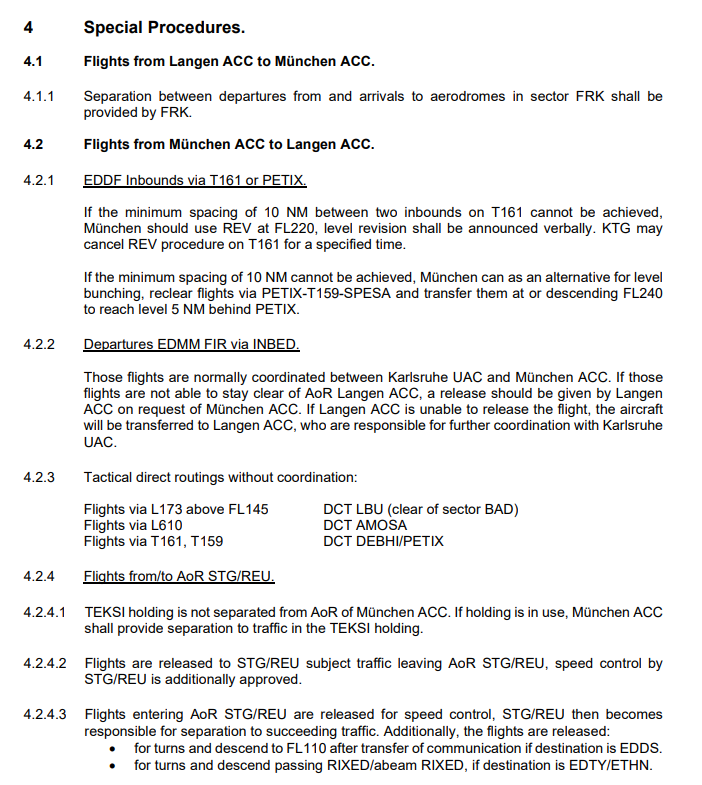
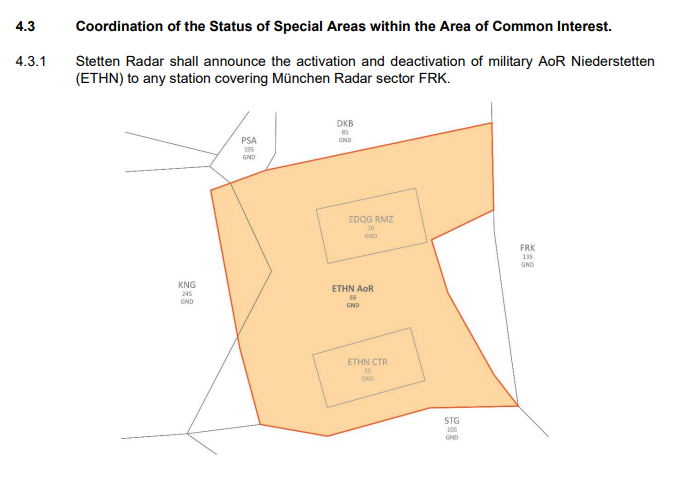
3) Special Procedures, Areas, etc.
In some LoAs/LoPs Special Procedures are listed to ensure correct trafficflow and define more parameters for one or more routes. Furthermore special areas can be published to raise awareness for the controllers.
Example: LoA Identifying Special Procedures
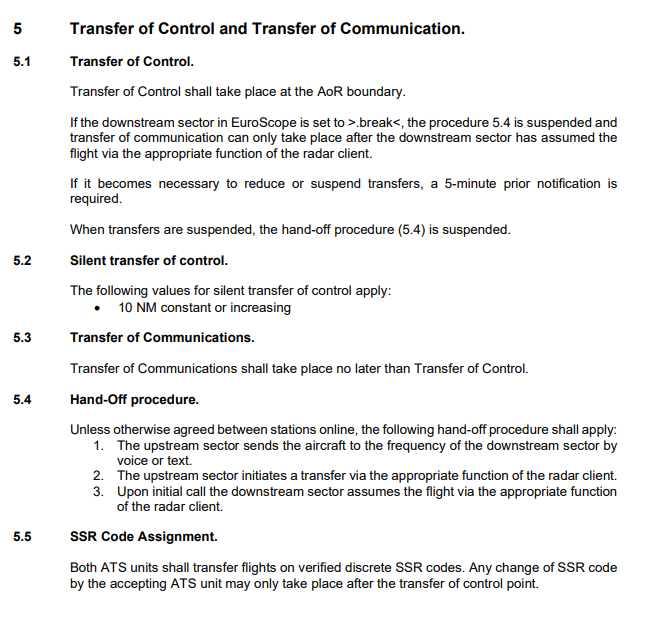
4) Transfer of Control and Transfer of Communication
At the end of a LoA/LoP, you can usually find a description for the correct Transfer of Control and Transfer of Communication.
Example: LoA Identifying Transfer Of Coms and Control
Where to find the LoAs/LoPs?
LoAs and LoPs can be found in the knowledgebase of VATSIM Germany or via the following link: https://knowledgebase.vatsim-germany.org/shelves/loa
Furthermore LoAs and LoPs can be found in ATCISS: https://atciss.vatsim-germany.org/loa