
Independent Approach Operations (BER)
Introduction and a word on efficiency
During high traffic operations in Berlin independent parallel approach operations may be used. The following guide shall give a deeper look into the rules, requirements, best practices and general operations.
Since dependent parallel approaches already enable a diagonal reduction of spacing on final to 1.5 NM, the theoretical increase in efficiency is only so much. However, it can often relieve a packed feeder frequency and facilitate the arrival-traffic throughput during very high traffic inbound rushes.
Besides the requirements listed further down below, it does not make sense to switch to independent approach operations when…
- …there is not enough traffic to fill up the finals. In these cases normal intercepts via 10 NM final are much more efficient.
- …the pickup controllers do not have enough capacity (high workload) to fill up the downwinds with enough traffic for independent operations to turn out efficient.
Requirements (EASA)
REQUIREMENTS AND PROCEDURES FOR INDEPENDENT PARALLEL APPROACHES (EASA)
Staffing:
Separate air traffic controllers are responsible for sequencing and spacing of arriving aircraft to each runway.
→ Both Feeder positions and both Tower positions need to be staffed. The exception that exists in real life, where only one Feeder may perform Independent Approaches in Berlin does not apply on VATSIM.
Informing the pilots:
- As early as practicable after an aircraft has established communication, the approach control unit advises the aircraft that independent parallel approaches are in force (e. g. ATIS)
- Aircraft are advised as early as possible of
- the assigned runway
- instrument procedure
- any additional information considered necessary to confirm correct selection
Aerodrome and procedural requirements:
- Runway centerlines are spaced by minimum of 1035 m
- The instrument approach procedure that aligns the aircraft with the extended runway centerline is a precision approach procedure
- The nominal tracks of of the missed approach procedures diverge by at least 30 degrees
- A NTZ of at least 60 m (2 000 ft) wide is established equidistant between extended runway centerline
Separation by ATC:
Aircraft do not penetrate the depicted No Transgression Zone (NTZ) by instructions as follows:
A minimum of a nominal 1 000 ft vertical separation or, subject to ATS surveillance system capabilities, a minimum of 3.0 NM horizontal separation is provided between aircraft on adjacent approaches until both aircraft are established on a final approach course or track.
None of the following meteorological conditions exists:
- windshear
- turbulence
- downdrafts
- strong crosswind
- other significant meteorological such as thunderstorms which might otherwise increase deviations from the final approach course or track to the extent that safety may be impaired.
Arrival Sequencing
Intercept Levels
RWY 06L/24R (North): shall intercept at minimum 5000 ft or higher
RWY 06R/24L (South): shall intercept at 3000 ft or 4000 ft
Handoff to Arrival (Feeder)
- RWY 06L/24R: at 6000 ft to DBANT (on EDDB QNH)
- RWY 06R/24L: at 4000 ft to DBAST (on EDDB QNH)
Arrival (Feeder) Stations
- DBANT = EDDB_AN_APP (136.105): responsible for 06L/24R
- DBAST = EDDB_AS_APP (121.130): responsible for 06R/24L
Turn-On Points
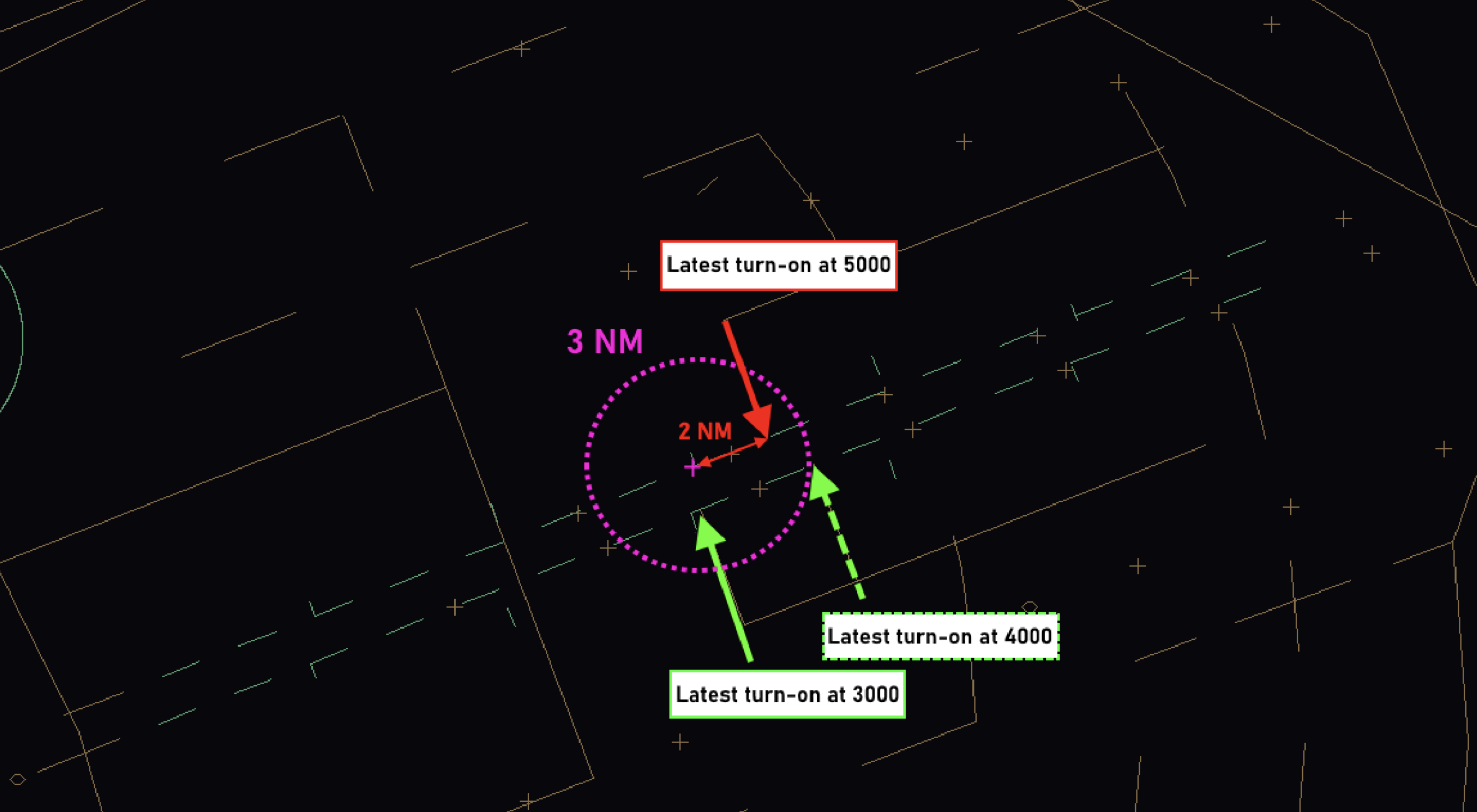
During Independet Approach operations, aircraft must fly 2 NM level while established on final track prior intercepting the glide path.
High final:
For runway 24R/06L the rule above means aircraft intercepting at 5000 ft start descending at ~15 NM final and must therefore intercept at 17 NM final or longer.
Low final:
Since aircraft intercepting 24L/06R need to stay separated with at least 3 NM/1000 ft until established on final track, their latest turn-on point for an intercept at 4000 ft is 3NM away from the 15 NM final of the high final (purple circle). Same applies for the 3000 ft latest turn-on, it is 3 NM away from the 12 NM final of the high final.
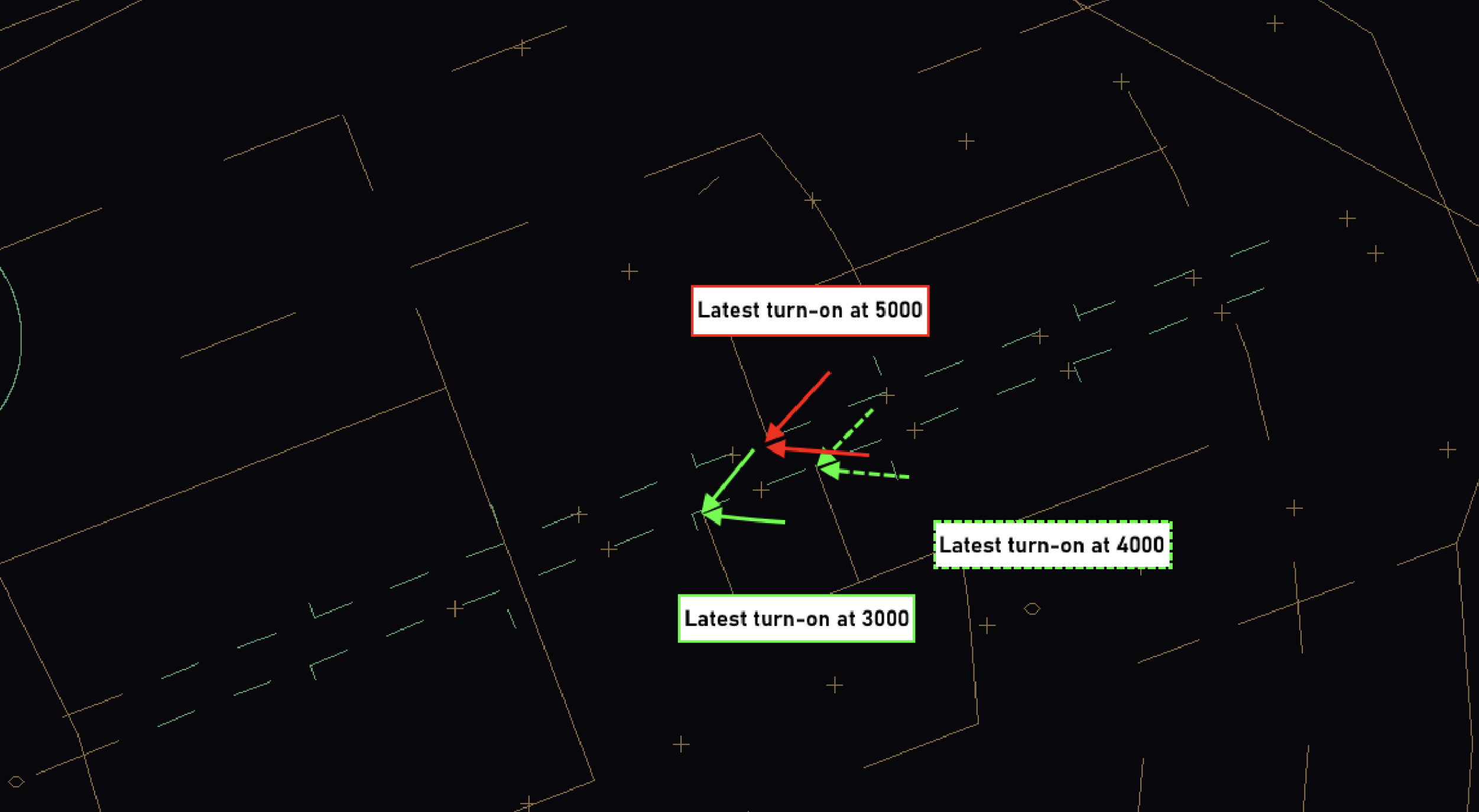
Final turns:
Intercept angles for the final track must not exceed 30 degrees!
Base Turns
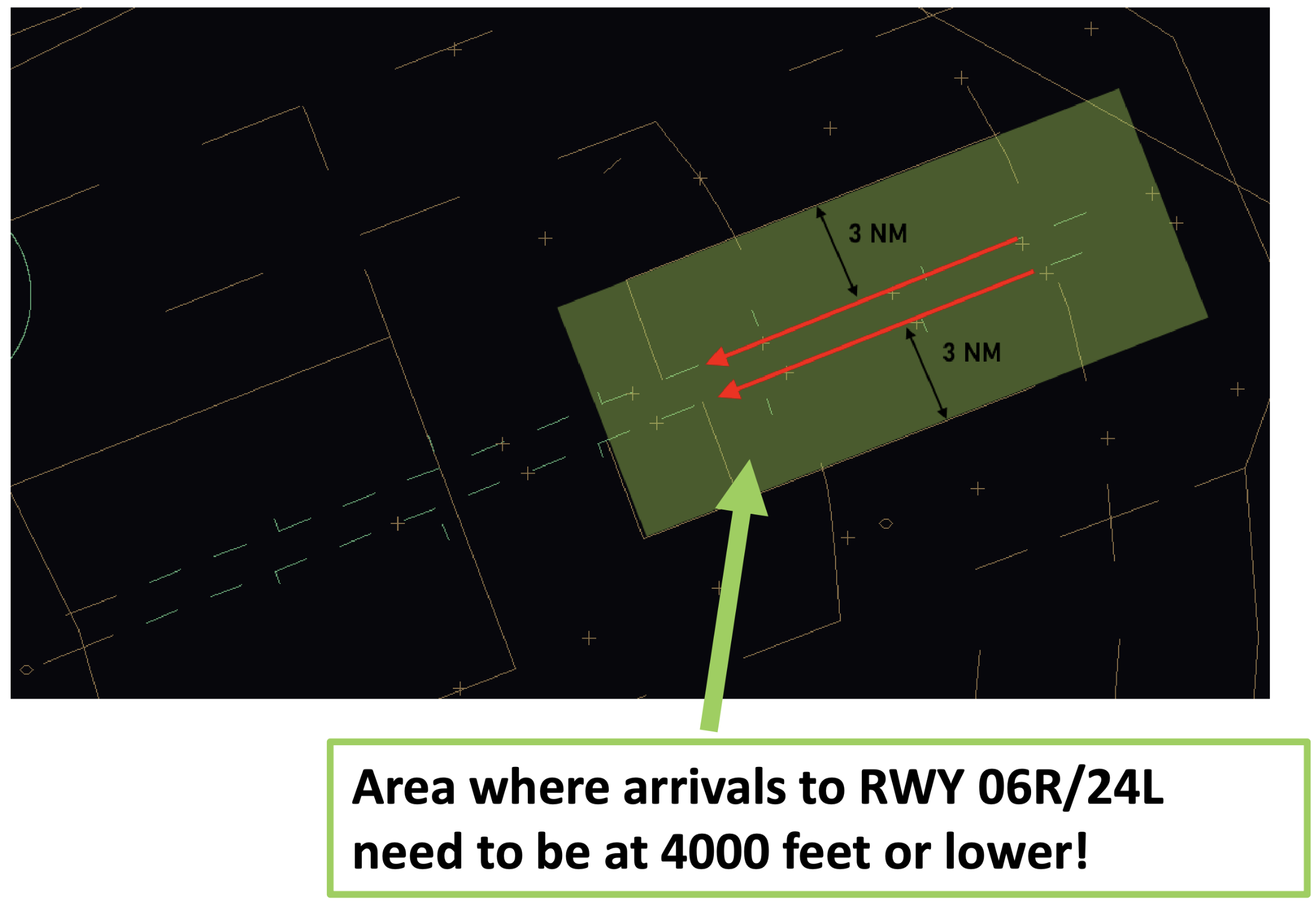
The Feeder responsible for the low final (south) shall not clear aircraft towards the final until they have vacated the intercept level of the high final (north). That means aircraft scheduled for 24L/06R must be at or below 4000 ft inside the IPA turning boxes (see image below).
Never turn an aircraft on base leg for the south final unless they have established 1000 ft separation to the north final!
MVA and Airspace
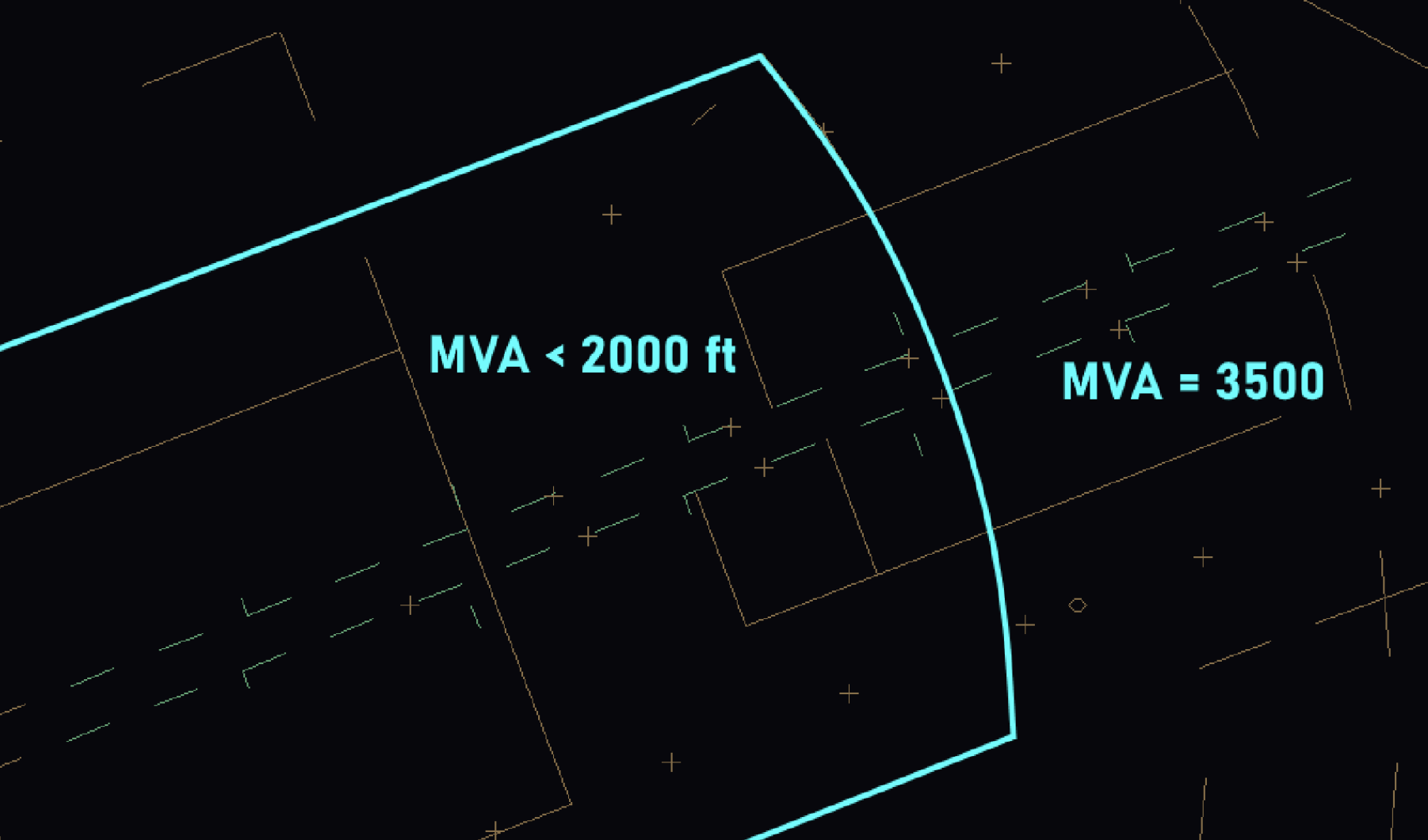
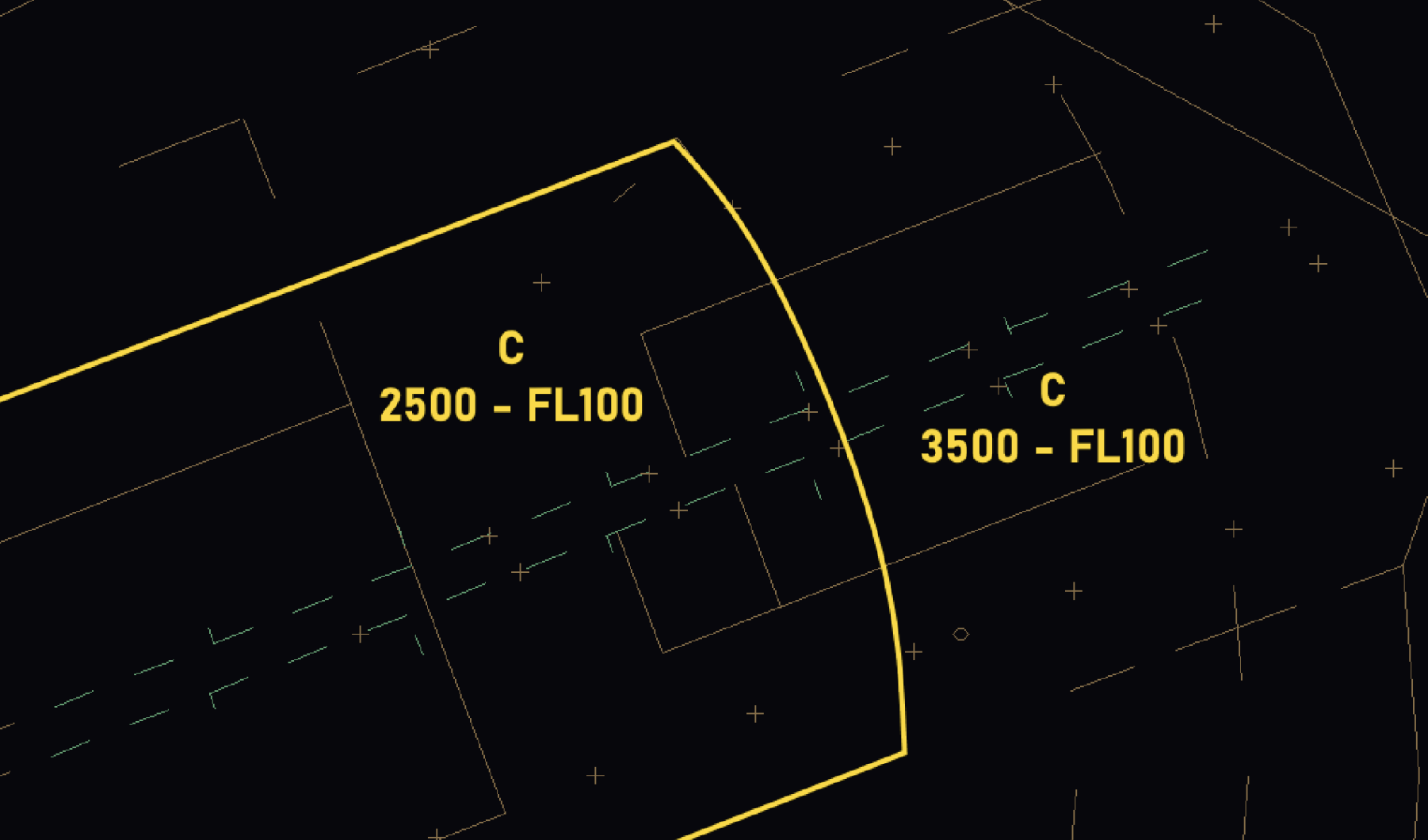
Always pay close attention to the MVA and airspace structure when working south feeder! It may not be possible to turn aircraft base before they reach the limits of the lowered MVA and airspace class C. In these cases, hold aircraft at 4000 ft and let them intercept within the respective turn-on area.
South feeder should always plan ahead and evaluate whether a base turn before reaching the 3500 ft MVA is possible or not. If that is the case, aircraft should be cleared to 3000 ft on initial contact to get the aircraft low enough as early as possible.
Non Transgression Zone (NTZ)
- Width 610 m
- This leaves 645 m normal operation zone on either side
If an aircraft deviates from the localizer and enters the NTZ, separation must be achieved immediately by turning out the other aircraft from the localizer.
Phraseology:
TURN LEFT (or RIGHT) (number) DEGREES (or HEADING) three digits) IMMEDIATELY TO AVOID TRAFFIC [DEVIATING FROM ADJACENT APPROACH], CLIMB TO (altitude)
Transfer to Tower
Transfer to Tower frequencies will take place when established on localizer at about 14 NM from Touchdown.
Tower controllers and Approach controllers shall monitor the approach at any time!
Perspective of the Pickup-Controller
Runway allocation
In order to maximize efficiency and runway throughput, we remind you that the runway allocation may be altered from the standard runway assignment procedure to achieve better load balancing. This especially applies to aircraft falling into the "MAY" category. It is the responsibility of both Pickup controllers to observe the current load balance and adjust runway assignments accordingly. Sometimes opening a Coordinator position may help to take over this task.
Handoffs to Arrival (Feeder)
Aircraft approaching two different runways do not have to be sequenced to have a minimum spacing in between them like it is recommended during normal operations. You can always hand them off on top of each other, they will be handled independent, after all.
Switching to Independent Approach Operations
Only after coordination with DBANT/DBAST the mode of operation is changed:
- DBAS shall notify DBAN, FLG, MAR and Berlin Tower about the mode of operation change.
- DBANT/DBAST shall activate turning area (Areas folder in TopSky Maps)
- ATIS shall be changed to display "EXPECT INDEPENDENT PARALLEL ILS APPROACH [RUNWAYS]"
- All aircraft already in the arrival sectors (DBAN, DBAS, DBANT or DBAST) shall be notified about the mode of operation change.