
Tower
Hamburg Tower is responsible for all arriving and departing traffic. The top level of the airspace D control zone is 2500ft MSL. Above this altitude, airspace C covers this area around Hamburg within responsibility of Hamburg East/West Approach.
 Controlzone of Hamburg Airport - © openflightmaps.org
Finkenwerder: In the west side of the control zone is the Airbus Airport Finkenwerder EDHI. Traffic to and from Finkenwerder can cause critical situations in Hamburg. The responsible radar controller will give information about traffic. It may be necessary to:
- clear VFR aircraft in the area
- hold back departures, in coordination with radar
Additionally, when EDHI_TWR is unstaffed the whole aerodrome or some procedures (e.g. VFR from EDDH for one touch and go in EDHI) can be delegated from radar to Hamburg Tower.
Hamburg CTR, Boberg Sector: only active at 33 arrivals or 15 departures
Ham-Finkenwerder CTR: only active with traffic in EDHI - airspace is in responsibility of Finkenwerder Tower (or Hamburg East Approach top-down)
Runways
Hamburg has a dependent crossing runway system with two runways.
Preferred Runway Config: 23 arrival and 33 departure is preferred and is used as long as possible (5kt tailwind component, pilot reports). All other runway configurations decrease your efficiency, increase target spacing for arrivals and causes more congestions on the ground.
Helper: EDDH Wind/Runway Chooser
Specialties
Visual example
blue = landing traffic RWY 23, orange = traffic ready for departure RWY 33
 |
 |
| Runway 33 blocked! | Runway 33 clear, a take-off clearance can be issued |
Crossing Runway Wake Turbulence Separation
Due to the position of the runway cross and the distinct system of separated landing and departure runways, there are only two situations which need to be watched for crossing wake turbulence separation:
- 05 or 15 departure with a go-around on the other runway. Departure needs to be delayed anyway due to missed approached procedure leading to HAM VOR!
- 33 light type departures before the runway cross. Prefer to assign intersection D9/A6 at the runway cross
Area of Responsibility
 Additionally in Euroscope: Ground View > Functions > Maps > AoR
Movement at GA delegated to Tower (green area): Taxiing out of and into the general aviation parking area is delegated to tower to ensure a steady traffic flow. Parking positions are not assigned to arriving traffic. Outbound traffic should be handed off to tower when they report ready for pushback or taxi, whichever comes first.
Departures
General Departure-Release: Departures do not have to be released by EDWW (Bremen Radar) unless:
- EDWW explicitly restricts departures by time, SID or until further notice
- Departures out of the non operational runway config
- The first departure after a runway change
- The first departure after an unplanned missed approach
- Departures using OID or vectored departure
Auto-Handoff: Hamburg has an auto-handoff to the departure frequency when passing 2000ft, as stated in the charts. A short "bye bye" at the end of the take-off clearance can help vPilots to get the hint.
Spacing: Departures shall be separated with a minimum of 3nm or wake turbulence separated, whichever is greater. When two aircrafts have the same SID the separation shall be increased to 5nm or wake turbulence separation whichever is greater. Different aircraft performances and climb speeds need to be taken into account.
Efficiency: Try to sequence departures with alternating SID directions, left/right in relation of the runway track. In case of two westbound departures (different SIDs) out of runway 33, more spacing (5nm) is preferred but not mandatory, as all aircrafts fly the same route until ELSOB.
As there are distinct landing and departure runways, use lineups constantly to issue take-off clearances as soon as possible.
Arrivals
Approaches: By default, the ILS Approach is used for all arrivals, except runway 33 or coordinated otherwise.
Runway 23 (very often): The target spacing is only 3nm on runway 23. In high traffic situations pilots need to vacate as soon as possible. Most of the time the phrase "taxi left via D1, hold short of runway 33" is used.
Runway 15 (regularly): The first exit is E4 to the left. Depending on the spacing on the final and planed parking position, long rollouts might be instructed to vacate left via A6 or right via D9.
Runway 05 (some times): Same as runway 23 pilots should vacate as soon as possible and be guided onto D1. In this case to have enough time for departures out of runway 33 before the next arrival is on short final.
Runway 33 (only at very strong winds): This RNP only approach is being avoided as long as possible as its path is directly above Hamburg city. All arriving traffic will taxi via E1 to hold short of runway 23 within the responsibility of the tower.
One of your primary objectives with arrivals is to keep the runways useable. Unfortunately some vPilots will hold before the holding line blocking the runway, unless you keep them rolling. Issue taxi instructions as soon as possible.
Handover to apron will take place as early as possible, at the latest when reaching the boundary of responsibility.
Separation on Final
- Generally, the responsibility for the separation of flights subject to separation in CTR Hamburg (Airspace D) lies with Hamburg Tower. Hamburg Arrival / Bremen Radar is responsible for separation of IFR flights on Final.
- After the transfer of communications from Hamburg Arrival / Bremen Radar, Hamburg Tower is responsible for monitoring the separation between arriving aircraft. If necessary, Tower shall also use methods to ensure separation on the final.
- Hamburg Tower may adjust the speeds of aircraft on final without prior coordination. If this is done, Tower is solely responsible for separation of all affected aircraft.
Missed Approaches
In case of an unplanned missed approach, the Tower controller shall inform Hamburg East Approach immediately. Traffic will be handed over to Hamburg East Approach after coordination.
The next departure is always subject to release, if not coordinated otherwise (Departure Release).
Efficiency
Sequencing traffic: Keep up clearances and rolling instructions. A good sequence on default config (23/33) looks like:
- Landing Clearance runway 23
- Lineup runway 33
- Cross D1 traffic at runway 33 and send to East Apron
- Takeoff Clearance runway 33
- Taxi arrival on D1 hold short runway 33
Reduced Runway Separation (RRS)
Hamburg Airport (EDDH) is approved to apply the following reduced runway separation minima during day and night:
| Runway |
CAT 1 following a departing CAT 1 or 2 | CAT 2 following a departing CAT 1 or 2 | CAT 1 to 3 following a departing CAT 3 |
| RWY 05/23 | 600 m | 1500 m | 2400 m |
| RWY 15/33 | 600 m | 1500 m | 2400 m |
VFR
Hamburg offers several options for traffic under VFR. All VRP are mandatory to report. There are published holding patterns north and south of runway 05/23 and east of runway 15/33. (Caution: not every virtual pilot is familiar with these holdings)
| VRP | NAV |
|---|---|
| N1 | East abeam Kisdorf/Henstedt-Ulzburg |
| N2 | Large roundabout at federal street B432 |
| D | Highway junction A1 and A24 |
| T1 | Bridge of federal street B75 leading above the railway tracks |
| T2 | Track harp the cargo rail station Hamburg Süd (Veddel beim Spreehafen) |
| H | Marina/Yachthafen Hamburg, River Elbe |
| P1 | Highway exit A23 Pinneberg-Nord, Radio Tower |
| P2 | Highway junction A7 and A23 |
VRP H: Even though this VRP does not serve as a VRP for arriving and departing traffic, it can be useful to use for traffic entering or leaving the CTR along the Elbe river.
Finkenwerder: Good coordination between tower and approach is needed in case of traffic at EDHI Finkenwerder.
VFR Departure Efficiency: Take into consideration where the traffic is leaving the CTR and avoid an unnecessary runway overfly after take-off. For example at 23/33: VFR leaving the CTR to the south can better be departed from runway 23 without blocking the departure sector or a runway overfly / crossing the final.
VFR Traffic Circuits: Try to use the traffic circuit of the landing runway without crossing the departure runway. This avoids most of the wake turbulence separations and departure delays.
Examples:
- traffic circuit 23 behind 33 departures
- right traffic circuit 05 behind 33 departures
- traffic circuit 15 behind 23 departures
VFR - Tower (EDDH_VFR_TWR)
Tower, East Apron, and Delivery need to be online before the VFR Tower can be staffed.
Usually only staffed at the Hamburg Harbor Festival and the Overload Real-life Event.
In reality the Hamburg VFR Tower is a station to provide precise traffic information using radar coverage and to organize the VFR traffic flow efficiently. Its area of responsibility includes all VFR flights in the area of the control zone, as well as entry/exit/through flights. Traffic circuits and runway clearances remain the responsibility of the normal EDDH_TWR.
In order to provide traffic information with exact and verified altitude information, the EDDH_VFR_TWR may assign squawks and delegate the squawk assignment for departing traffic from Hamburg to Apron/Tower. Departures are handed over to the radar tower after takeoff. Individual arrangements can be made for handovers of approaches to Hamburg but for certain runway configurations the Outer Alster is recommended as a visual reference point in the south of the airport.
The efficient handling of traffic can only be guaranteed through good cooperation and coordination between the tower and the radar tower.
Helicopters
Departures directly from the parking position are not permitted. All helicopter traffic needs to air-taxi from and to the helipad, except helicopters based at the police station.
Helipad West: Main arrival/departure point for helicopters in Hamburg.
Helipad East: Helipad East between B1 and B3 is not used that often or is closed via NOTAMS. Prefer using Helipad West.
Police helicopters: The police helicopters are based at Hamburg Airport east of apron 5 (H Pol1 / H Pol 2), Callsign "Libelle". These helipads are not reachable via air-taxi and can only be used for direct arrival/departures. Pilots will communicate directly with the tower.
Rescue helicopters: There are no rescue helicopters located at the airport but within the area of the tower control zone. In EuroScope the surrounding hospitals with helicopter platforms are marked as square with an x inside. The names can be activated with ALT-H.

Low Visibility Procedures (LVP)
Low Visibility Procedures will be applied when:
- RVR ≤ 600 m or ceiling/vertical visibility < 200 ft
EDDH is approved up to CAT III for runway 23 with a minimum RVR of 75 m. Additionally, guided take-off is available from RWY 23 if the RVR is ≤ 125 m but ≥ 75 m. RWY 33 is approved for Low Visibility Takeoffs (LVTO) up to an RVR of > 125 m. RWY directions 05 and 15 are not approved for use during LVO.
Hamburg Tower shall inform DEL, GND and APP about the beginning and termination of LVP.
Further general information is available here.
Runway Configuration
The following RWY configurations shall be used whenever equipment and weather conditions permit:
- If RVR > 125 m: DEP 33, ARR 23
- If RVR ≤ 125 m: DEP and ARR 23 only
Standard config (33/23) is the preferred configuration as it requires less spacing between arriving traffic.
The use of 23 single-ops is mandatory with an RVR at or below 125 m. Any other RWY configuration is not allowed during LVO.
ATIS and Ground Radar
ATIS Setup
Whenever LVO conditions exist, it shall be broadcast in the ATIS.
The following shall be announced whenever Low Visibility Conditions are in effect:
- LOW-VISIBILITY PROCEDURES IN OPERATION, CAT II AND III AVAILABLE
The following shall be announced if the RVR is ≤ 125 m but ≥ 75 m:
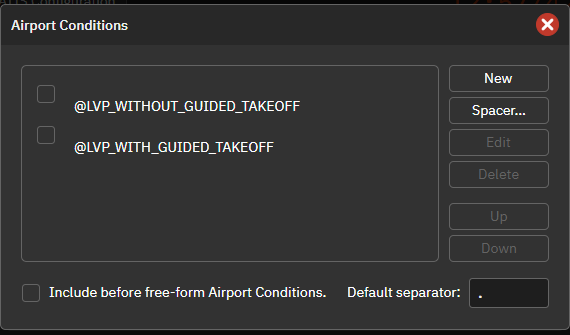
- LOW-VISIBILITY PROCEDURES IN OPERATION, CAT III AND GUIDED TAKE-OFF AVAILABLE
This can be selected in the vATIS airport conditions dialogue.
Ground Radar Setup
The Tower controller shall activate the "LVP" mode of the Groundradar Plugin. This activates LVO safety buffers and displays the CAT II/II holding points. Additionally, the position of the localiser will be displayed.

Separation
Whenever the LVP separation minima is not met, a Go Around should be instructed.
Arrivals to Arrivals
During LVO, the preceding arriving aircraft must cross the CAT II/III holding point before the succeeding aircraft passes 2 NM final.
Departures to Departures
Between two departing aircraft, full runway separation shall be applied. The use of RRS is prohibited.
When the RVR is ≤ 125 m, guided takeoff should be available for RWY 23. In this case, the preceding departing aircraft needs to have overflown the LOC before the succeeding aircraft can commence its take-off roll. The localizer shall be displayed on the ground radar (red line left of the runway's threshold).

Alternatively, &lvp can be used when using the uniatis ATIS link.
Departures to Arrivals
When using 23-single Ops: To avoid interference with the ILS signals, the preceding departing aircraft on the same runway needs to be clear of:
- The critical area before any succeeding aircraft reaches a 4 NM final,
- The sensitive area before any succeeding aircraft reaches a 2 NM final.
Full runway separation needs to be applied. The use of RRS is prohibited.
For simplicity, the critical area is defined by the runway area starting at the CAT I holding points, whereas the sensitive area is considered as the runway area defined by the CAT II/III holding points.
On Vatsim when using 33/23, the critical and sensitive areas are considered cleared once the departing or arriving aircraft has passed the runway crossing.
In case of a preceding arriving aircraft on the same runway, the succeeding departing aircraft may commence its take-off roll once the arriving aircraft has crossed the CAT II/III holding point.