
Tower
Bremen Tower is responsible for all movements on the runways and traffic flying inside the Bremen CTR.
Control Zone

Bremen CTR reaches from the ground to an altitude of 2500 ft MSL. Bremen Radar (sector Friesland) is responsible for movements inside Bremen airspace class D (non-CTR).
Runways
Runway 08/26 is the only available runway for IFR and landing VFR traffic. The runway direction shall be based on the current wind situation at the aerodrome.
Runway 23
Runway 23 can be used during the daytime and if the wind conditions permit. This runway shall only be used on the explicit pilot's request and only for VFR departures of up to 5700 kg MTOM requesting to leave the CTR via SIERRA, WHISKEY, or NOVEMBER.
Beluga Special Runway
Both runway thresholds are connected to runway extensions increasing the TORA by roughly 300 m. These paved RWY extensions in front of the respective thresholds shall only be used as special take-off runways for Beluga and Beluga XL aircraft (A3ST and A337).
Reduced Runway Separation (RRS)
Bremen Airport (EDDW) is approved to apply the following reduced runway separation minima during day only:
| Runway |
CAT 1 following a departing CAT 1 or 2 | CAT 2 following a departing CAT 1 or 2 | CAT 1 to 3 following a departing CAT 3 |
| RWY 08/26 | 600 m | 1500 m | --- |
Departing Traffic
Departing IFR traffic will automatically switch to the departure frequency stated in the ATIS when airborne.
The Beluga XL (A337) requires a backtrack from intersection C to depart from RWY 08 as this aircraft exceeds the wingspan limit at taxiway N.
Departure Releases
Departures do not have to be released by EDWW (Bremen Radar) unless:
- EDWW explicitly restricts departures by time, SID or until further notice
- Departures out of the non-operational runway config
- The first departure after a runway change
- The first departure after an unplanned missed approach
Arriving Traffic
After landing, Bremen Tower shall issue the initial taxi clearance via F (RWY 08) or A (RWY 26) and transfer the aircraft to Bremen Ground.
For jet aircraft with an MTOM of more than 20 t, landing on runway 26, Bremen Tower shall instruct the pilot to vacate via taxiway A before issuing the landing clearance. After coordination with Bremen Ground, this traffic may also be approved to vacate via C.
Traffic landing on runway 08 with a wingspan of more than 36 m shall be instructed to vacate the runway via taxiway F before issuing the landing clearance.
The Beluga XL (A337) requires a backtrack from RWY 26 to leave via taxiway C as this aircraft exceeds the wingspan limit at taxiway N. The pilot shall be informed about these procedures before issuing the landing clearance. The backtrack is performed at the designated Beluga Special Runway.
VFR Traffic
Traffic requesting traffic circuit flights may preferably be cleared for the southern downwind due to noise-abatement reasons. Still, using the northern downwind is not prohibited per se.
Departing VFR Traffic
Departing VFR traffic will initially contact Bremen Ground. Bremen Ground will inform Bremen Tower about the intentions of the departing VFR traffic.
Generally, Runway 26 is the preferred runway for VFR departures. Runway 23 should be used on the explicit pilot's request only!
Traffic requesting to depart from runway 08 to leave the CTR via WHISKEY shall only take off from runway intersection A.
Departures from runway 23 to leave the CTR via NOVEMBER shall only initiate the right turn after departure, after explicit instruction from Bremen Tower. Bremen Tower shall make sure that no conflict with arriving or departing traffic via runway 08/26 exists before issuing the right turn.
VFR departure for Jets and Aircraft with a MTOM of more than 5700 kg
Jet aircraft or any aircraft with an MTOM of more than 5700 kg shall follow a published IFR departure route under VFR conditions. In this case, Bremen Ground shall coordinate the departure routing with Bremen Tower.
Despite Bremen Ground previously issuing the expected departure procedure to the pilot, Bremen Tower shall also instruct the departure procedure before takeoff clearance.
The departure routes may be issued for IFR traffic, except the following maximum altitudes after departure shall be used:
| Maximum Altitude | RWY 08 | RWY 26 |
| Maximum 2000 ft or below | ABDIM, WIMCI, NIE | OKWEL, NIE, GESTO, WSN, OKWEL |
| Maximum 1500 ft or below | OKWEL, GESTO, WSN | ABDIM |
Example: "DEABC, leave control zone VFR via NIE6Z departure in 2000 ft or below, after departure remain this frequency."
The departure routing shall be assigned depending on the requested or filed waypoint from the pilot. If requested by the pilot, Bremen Tower may coordinate an entry into airspace class D (non-CTR) with Bremen Radar to enable a climb above the mentioned altitudes.
Arriving VFR Traffic
Arriving traffic shall be guided via the published CTR entry procedures.
Jet aircraft or any aircraft with an MTOM of more than 5700 kg shall only enter the CTR via a published IFR approach (e.g. ILS). This traffic shall contact Bremen Radar to join the published approach. Bremen Tower will not provide vectoring service for such traffic.
Rescue Helicopter Traffic
Christoph 55
The rescue helicopter Christoph Weser (CHX55) is stationed at Bremen airport. It usually parks in front of the DRF hangar (Hangar K). Departures and arrivals will be performed via the takeoff and landing platform between taxiways H, C and F. This platform shall only be used for rescue helicopter traffic. The platform may also be called "Yankee" unofficially.

For departure, Bremen Tower will be contacted directly. In all cases, Bremen Tower shall inform Bremen Ground about any movement via the takeoff and landing platform (arrivals and departures).
It is important to note that the platform "Yankee" is not to be considered a helipad. It functions as a takeoff and landing platform comparable to other hospitals in the CTR. Therefore, no takeoff and landing clearance shall be given! Traffic will depart and land at its own discretion.
Examples:
"Christoph 55, cross Hotel, wind 100 degress 5 knots, takeoff Yankee own discretion, proceed direct [...]."
"Christoph 55, wind 100 degress 5 knots, land Yankee own discretion, cross Hotel, approved to leave on ground."
The use of the taxiways triangle F-C-H is prohibited during every takeoff and landing at Yankee!
Other Rescue Traffic
Within Bremen CTR, three hospitals with helipads exist. Rescue helicopter Christoph 6 (CHX06) is stationed at "Klinikum Links der Weser" which may also be called "Pad Zulu" unofficially. Bremen Tower shall announce the current wind situation at EDDW whenever a rescue helicopter reports approaching the destination. A map with all hospitals can be toggled with ALT + H in the Euroscope package.

Low Visibility Procedures (LVP)
WhenLow Visibility Procedures will be applied when:
- RVR ≤ 600 m or ceiling/vertical visibility < 200 ft
EDDW is approved up to CAT III operations. Additionally, guided take-off is available if the weatherRVR conditionis requires≤ low125 visibilitym operationsbut the≥ use75 shall be announced in the ATIS. Additionally,m. Bremen Tower shall inform Bremen GroundGND and Bremen RadarAPP about the beginning and termination of Low Visibility Procedures.LVP.
useFurther &lvpgeneral information is available here.
ATIS and Ground Radar
ATIS Setup
Whenever LVO conditions exist, it shall be broadcast in the ATISATIS.
The URLfollowing orshall "LOWbe VISannounced OPS"whenever flagLow Visibility Conditions are in effect:
- LOW-VISIBILITY PROCEDURES IN OPERATION, CAT II AND III AVAILABLE
The following shall be announced if the RVR is ≤ 125 m but ≥ 75 m:
- LOW-VISIBILITY PROCEDURES IN OPERATION, CAT III AND GUIDED TAKE-OFF AVAILABLE
This can be selected in the NOTAMvATIS menuairport conditions dialogue.
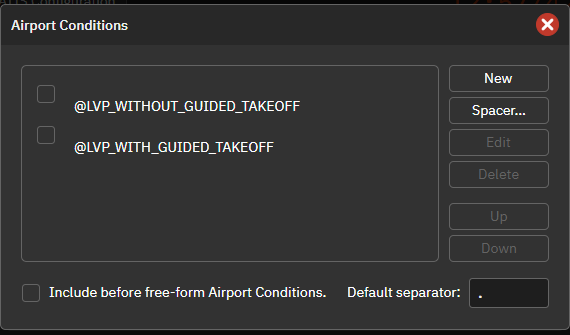
Alternatively, &lvp can be used when using the uniatis ATIS link.
Use of vATISTWYs and Intersection Departures
When low-visibility conditions exist, Bremen Tower shall instruct arriving traffic to vacate via taxiway F (RWY 08) or taxiway A (RWY 26) before issuing the landing clearance. The use of intersection departures is prohibited during low-visibility operations.
Separation
Whenever the LVP separation minima is not met, a Go Around should be instructed.
Arrivals to Arrivals
During LVO, the preceding arriving aircraft must cross the CAT II/III holding point before the succeeding aircraft passes 2 NM final.
Departures to Departures
Between two departing aircraft, full runway separation shall be applied. The use of RRS is prohibited.
When the RVR is ≤ 125 m, guided takeoff should be available. In this case, the preceding departing aircraft needs to have overflown the LOC before the succeeding aircraft can commence its take-off roll.
Departures to Arrivals
To avoid interference with the ILS signals, the preceding departing aircraft needs to be clear of:
- The critical area before any succeeding aircraft reaches a 4 NM final,
- The sensitive area before any succeeding aircraft reaches a 2 NM final.
Full runway separation needs to be applied. The use of RRS is prohibited.
For simplicity, the critical area is defined by the runway area starting at the CAT I holding points, whereas the sensitive area is considered as the runway area defined by the CAT II/III holding points.
In case of a preceding arriving aircraft, the succeeding departing aircraft may commence its take-off roll once the arriving aircraft has crossed the CAT II/III holding point.