
Tower
Stations and AoRs

| Station |
Station ID |
Frequency |
Login |
| Berlin Tower Nord |
DBTN | 120.030 |
EDDB_N_TWR |
| Berlin Tower Süd | DBTS | 118.805 | EDDB_S_TWR |
If both Tower are online, the CTR is divided into two AoRs with a border between the runways. In case Ground is offline, Tower will cover this station (DBTN will cover DBGN and DBTS will cover DBGS).
General
Modes of operation
Berlin Airport is authorized for the following modes of operations:
| Mode |
Spacing between 06L/24R and 06R/24L |
| Staggered Approaches | 3 NM |
| Independent Parallel Approaches | --- |
| Independent Parallel Departures | --- |
| Dedicated Runway Operations (DROps) | --- |
Staggered Approaches is the standard mode of operation. Independent Parallel Approaches will only be used whe required due to traffic. Parallel Operations (approaches and departures) cannot be performed with an aircraft on the ILS X.
Independent Parallel Approaches
During periods of high traffic, independent parallel approaches may be used.
REQUIREMENTS AND PROCEDURES FOR INDEPENDENT PARALLEL APPROACHES
-
- Approved approach types at EDDB for independent approaches:
- ILS Z
- RNP Z but only with vertical guidance (LNAV only not authorized).
Procedures and requirements can be viewed here: https://knowledgebase.vatsim-germany.org/books/sops-fir-bremen/page/independent-approach-operations-ber
Independent parallel approaches may be performed with only one Feeder online. Performing this mode of operation without a Feeder it not allowed.
SUSPENSION OF INDEPENDENT PARALLEL OPERATIONS DUE TO METEOROLOGICAL CONDITIONS:
The meteorological conditions to be considered include, but are not limited to, the following:
- wind shear;
- turbulence;
- downdrafts; and
- crosswind and significant meteorological conditions such as thunderstorms, which might otherwise increase deviations from the final approach course or track to the extent that safety may be impaired.
- Approved approach types at EDDB for independent approaches:
Independent Parallel Departures
Independent parallel departures shall always be used, except if the following requirements are not met:
REQUIREMENTS AND PROCEDURES FOR INDEPENDENT PARALLEL DEPARTURES
- Parallel runways may be used for independent instrument departures as follows:
- both runways are used for mixed arrivals and departures (mixed operation).
- Independent IFR departures should only be conducted from parallel runways when the conditions listed below are met:
- both aircraft are flying an RNAV or RNP instrument departure and
- ATS operational procedures ensure that the required track divergence is achieved.
- both runways are used for mixed arrivals and departures (mixed operation).
In case departing traffic deviates from the departure route, the responsible tower controller needs to create separation immediately.
Note: Vectored and visual departures are not approved for independent parallel departures
Parallel Operations (approaches and departures) cannot be performed with an aircraft on the ILS X.
SUSPENSION OF INDEPENDENT PARALLEL OPERATIONS DUE TO METEOROLOGICAL CONDITIONS:
The meteorological conditions to be considered include, but are not limited to, the following:
- wind shear;
- turbulence;
- downdrafts; and
- crosswind and significant meteorological conditions such as thunderstorms, which might otherwise increase deviations from the final approach course or track to the extent that safety may be impaired.
Dedicated Runway Operations (DROps)
In Berlin, dedicated runway operations will be used during the following conditions:
- Low Visibility Procedures
- Suspension of Independent Parallel Departures (e.g. due to CB, wind shear, turbulence, downdrafts, strong crosswind)
- Special regulation of traffic flows (e.g. shuttle event)
For Berlin, the following runway configurations are preferred for dedicated runway operations:
- 06-Operations: 06L departures, 06R approaches
- 24-Operations: 24L departures, 24R approaches
When the RVR falls below 1000 m and/or the ceiling is at or below 300 ft and CAT II/III operations are expected, Berlin Tower should use DROps and inform Berlin Ground about the beginning of the LVP preparation phase.
Segmented Approaches (ILS/RNP Y) and ILS X
Bremen Radar shall inform Berlin Tower about the use of segmented approaches (ILS/RNP Y), which will be used during times of low traffic. Bremen Radar will also inform Berlin Tower about aircraft using the ILS X.
The ILS/RNP Y requires a diagonal separation of 3 NM. Dependent parallel or alternating approaches are not allowed. Behind every aircraft flying the ILS X, a minimum separation of 15 NM is required on both runways.
The standard approach type is ILS Z. The RNP Z will be used whenever the ILS is not available or when requested by the pilot.
Target Spacing
The responsible approach controllers will use the following target spacings depending on the conditions:
| Conditions |
Target Spacing |
| Departures expected | 6 NM |
| No departures expected | 3 NM |
| Low Visibility Operations | 5 NM |
Note: Tower may ask the approach control to increase the target spacing in case traffic has to depart between approaching aircraft. Usually, the Berlin approach unit will take the situation of departing traffic on the ground into account.
As long as possible, Tower may use reduced runway separation to depart traffic between approaching traffic. Due to the mixed operations on both runways, Berlin Tower must use every gap sufficient for departing traffic.
Landing Clearance Line (LCL)
Due to mixed operations on both runways at EDDB, a landing clearance line is established 90 m from the runway's centerline to expedite landing and takeoff clearances. As soon as a landing aircraft has crossed the landing clearance line, a takeoff or landing clearance can be issued to any succeeding aircraft.
The landing clearance line can be used whenever the following conditions are met:
- The landing clearance line is visible on the ground radar display
- The braking action on the runway is not reduced significantly
- For Vatsim only SN, ST, PL, GR and GS are considered as a reduction of braking action
- The vacating aircraft does not exceed ICAO Code Letter E
- The vacating traffic does not stop until reaching the holding point

Reduced Runway Separation (RRS)
Berlin-Brandenburg Airport (EDDB) is approved to apply the following reduced runway separation minima during day and night:
| Runway |
CAT 1 following a departing CAT 1 or 2 | CAT 2 following a departing CAT 1 or 2 | CAT 1 to 3 following a departing CAT 3 |
| RWY 06L/24R | 600 m | 1500 m | 2400 m |
| RWY 06R/24L | 600 m | 1500 m | 2400 m |
Departing traffic
General Departure Release
Departures do not have to be released by EDWW (Bremen Radar) unless:
- EDWW explicitly restricts departures by time, SID or until further notice
- Departures out of the non-operational runway config
- Departures on visual or vectored departure routings
- Departures on an omnidirectional departure (OID)
- An arriving aircraft is performing on ILS X, established on final (release required for both runways)
- The first departure after a runway change
- The first departure after an unplanned missed approach
- After every departure route with the designator K, M or Z
Departure Separation
The following departure separation shall be used, except if wake turbulence separation is higher:
| Conditions |
Separation |
| Same SID following | 3 NM* |
| Different SID following | 3 NM |
* Note: In contrast to many other VATGER aerodromes, Berlin Tower may use 3 NM separation for same SIDs.
Handoff
Departing Traffic will be transferred to Berlin Departure when established on the SID. The following frequencies shall always be used if APP or DEP are staffed:
- Traffic departing runway 06L/24R: Bremen Radar - 120.340 (Departure Nord)
- Traffic departing runway 06R/24L: Bremen Radar - 120.630 (Departure Süd)
Intersection Departures
On the following intersections, Berlin Tower shall ask if traffic is in sight when using conditional clearances:
- Runway 06L: L3, L4, K2
- Runway 06R: M3, M5
- Runway 24R: L5, L6
- Runway 24L: M6, M7
Visual Departures
Visual departures can be used for both runways, but only for propeller aeroplanes of up to two engines and the aircraft type DHC-7 as well as helicopters.helicopters. Visual departures shall be coordinated with Bremen Radar individually and are subject to a departure release.
Arriving traffic
Separation on Final
-
- Generally, the responsibility for the separation of flights subject to separation in CTR Berlin (Airspace D) lies with Berlin Tower. Berlin Arrival / Bremen Radar is responsible for the separation of IFR flights on Final.
- After the transfer of communications from Berlin Arrival / Bremen Radar, Berlin Tower is responsible for monitoring the separation between arriving aircraft. If necessary, Tower shall also use methods to ensure separation on the final.
- Berlin Tower may adjust the speeds of aircraft on final without prior coordination. If this is done, Tower is solely responsible for separation of all affected aircraft.
Handoff
If Berlin Ground is staffed, traffic will switch to Ground automatically when vacated. This procedure shall be broadcast in the ATIS.
Missed Approaches
In case of a missed approach, the responsible Tower controller shall inform Berlin Departure North/South immediately. Traffic will be handed over to Berlin Departure after coordination. The next departure on the affected runway is always subject to release if not coordinated otherwise (Departure Release).
VFR traffic
Control zone
 CTR Berlin - © openflightmaps.org
VFR Procedures
- VFR movements preferred via runway 24R/06L
- Crossing of the airport as to be coordinated between both Tower controllers
EDAZ traffic
IFR traffic inbound to EDAZ will momentarily enter Berlin D(CTR). Bremen Radar shall inform Berlin Tower about every IFR arrival EDAZ latest on approach clearance. Bremen Radar is also responsible for informing Berlin Tower once this traffic has landed.
To ensure separation between departing traffic from EDDB and arriving IFR traffic from EDAZ, Berlin Tower shall:
- Instruct every IFR departure from runway 24L to climb at least 2000 feet per minute until passing 3000 ft ("Climb at 2000 feet per minute or greater until passing 3000 ft). This clearance can be assigned when issuing the take-off clearance. When in doubt, Berlin Tower should ask the pilot if he is able for this climb rate before issuing the line-up clearance.
Low Visibility Procedures (LVP)
Low Visibility Procedures will be applied when:
- RVR ≤ 600 m or ceiling/vertical visibility < 200 ft
EDDB is approved up to CAT III for both runways. Additionally, guided take-off is available if the RVR is ≤ 125 m but ≥ 75 m. Berlin Tower shall inform DEL, GND and APP/DEP about the beginning and termination of LVP.
Further general information is available here.
Runway Configuration
During LVO, Dedicated Runway Operations (DROPS) should be used:
- DEP: 06L or 24L
- ARR: 24R or 06R
DROPS should also be applied when the RVR is ≤ 1000 m or ceiling/vertical visibility is ≤ 300 ft and LVO is expected.
If the traffic situation allows, traffic parking north of RWY 06L/24R may be offered to use RWY 06L/24R for take-off or landing. This shall be coordinated with DEL, GND and APP/DEP. TWR shall consider the increased separation requirements.
ATIS and Ground Radar
ATIS Setup
Whenever LVO conditions exist, it shall be broadcast in the ATIS.
The following shall be announced whenever Low Visibility Conditions are in effect:
- LOW-VISIBILITY PROCEDURES IN OPERATION, CAT II AND III AVAILABLE
The following shall be announced if the RVR is ≤ 125 m but ≥ 75 m:
- LOW-VISIBILITY PROCEDURES IN OPERATION, CAT III AND GUIDED TAKE-OFF AVAILABLE
This can be selected in the vATIS airport conditions dialogue.
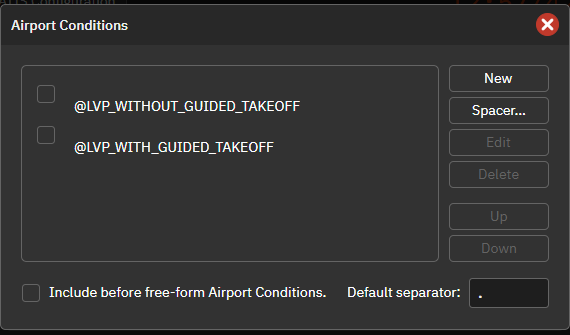
Alternatively, &lvp can be used when using the uniatis ATIS link.
Ground Radar Setup
The Tower controller shall activate the "LVP" mode of the Groundradar Plugin. This activates LVO safety buffers and displays the CAT II/II holding points. Additionally, the position of the localiser will be displayed.

Separation
Whenever the LVP separation minima is not met, a Go Around should be instructed.
Arrivals to Arrivals
During LVO, the use of the Landing Clearance Line (LCL) is allowed. In this case, the preceding aircraft (up to Code E) needs to cross the LCL before the succeeding aircraft passes 0.6 NM final or 200 ft AGL (400 ft MSL).
When the LCL cannot be used, the preceding aircraft must cross the CAT II/III holding point before the succeeding aircraft passes 2 NM final.
Departures to Departures
Between two departing aircraft, full runway separation shall be applied. The use of RRS is prohibited.
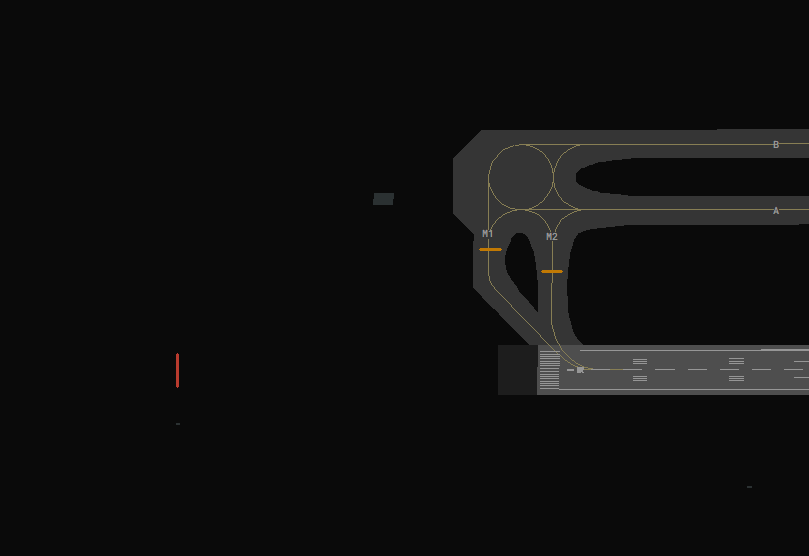
When the RVR is ≤ 125 m, guided takeoff should be available. In this case, the preceding departing aircraft needs to have overflown the LOC before the succeeding aircraft can commence its take-off roll. The localizer shall be displayed on the ground radar (red line left or right of the runway's threshold).
Departures to Arrivals
To avoid interference with the ILS signals, the preceding departing aircraft needs to be clear of:
- The critical area before any succeeding aircraft reaches a 4 NM final,
- The sensitive area before any succeeding aircraft reaches a 2 NM final.
Full runway separation needs to be applied. The use of RRS is prohibited.
For simplicity, the critical area is defined by the runway area starting at the CAT I holding points, whereas the sensitive area is considered as the runway area defined by the CAT II/III holding points.
In case of a preceding arriving aircraft, the succeeding departing aircraft may commence its take-off roll once the arriving aircraft has crossed the CAT II/III holding point.