Approach
Sectorization
München Radar sectors Thüringen Low Nord (TRN) and Thüringen Low Süd (TRS) are responsible for all arrivals and departures from/to Leipzig/Halle (EDDP), and TRS also services Erfurt-Weimar (EDDE), and the uncontrolled IFR airfield Leipzig Altenburg (EDAC).
TRS also covers Sachsen Low (SAS) unless EDDC_SAS_APP or EDMM_MEI_CTR are open. All controllers are expected to cross-couple the frequencies of the sectors they cover.
Leipzig Arrival South (EDDP_SD_APP) can be staffed as feeder position in EDDP. EDDP_ND_APP is not to be opened unless on a rostered event. EDDP_SD_APP cross-couples the EDDP_ND_APP frequency.
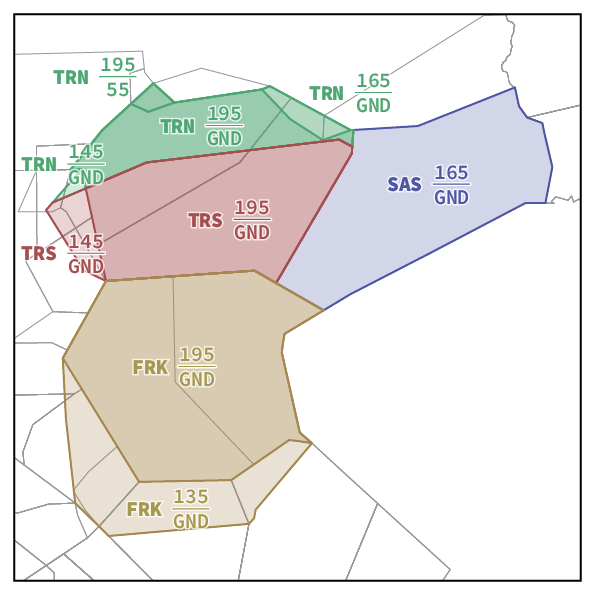
Approach sectors underlying EBG Ost
Airspace
Leipzig/Halle (EDDP)
Around Leipzig/Halle, Airspace D (non-CTR) is established up to FL75. Between FL75 and FL100, in the Airspace E band, an additional TMZ is established. VFR traffic is expected to squawk 4404 and monitor 126.175 (EDDP_TRS_APP).
Both Airspace D and the TMZ Leipzig consist of always-active parts, and HX parts that are active depending on the operating direction (26 – east active, 08 – west active).
IFR traffic should be kept within protected airspace during daytime. Speed restrictions of Airspace D (≤250 kt) may not be lifted.
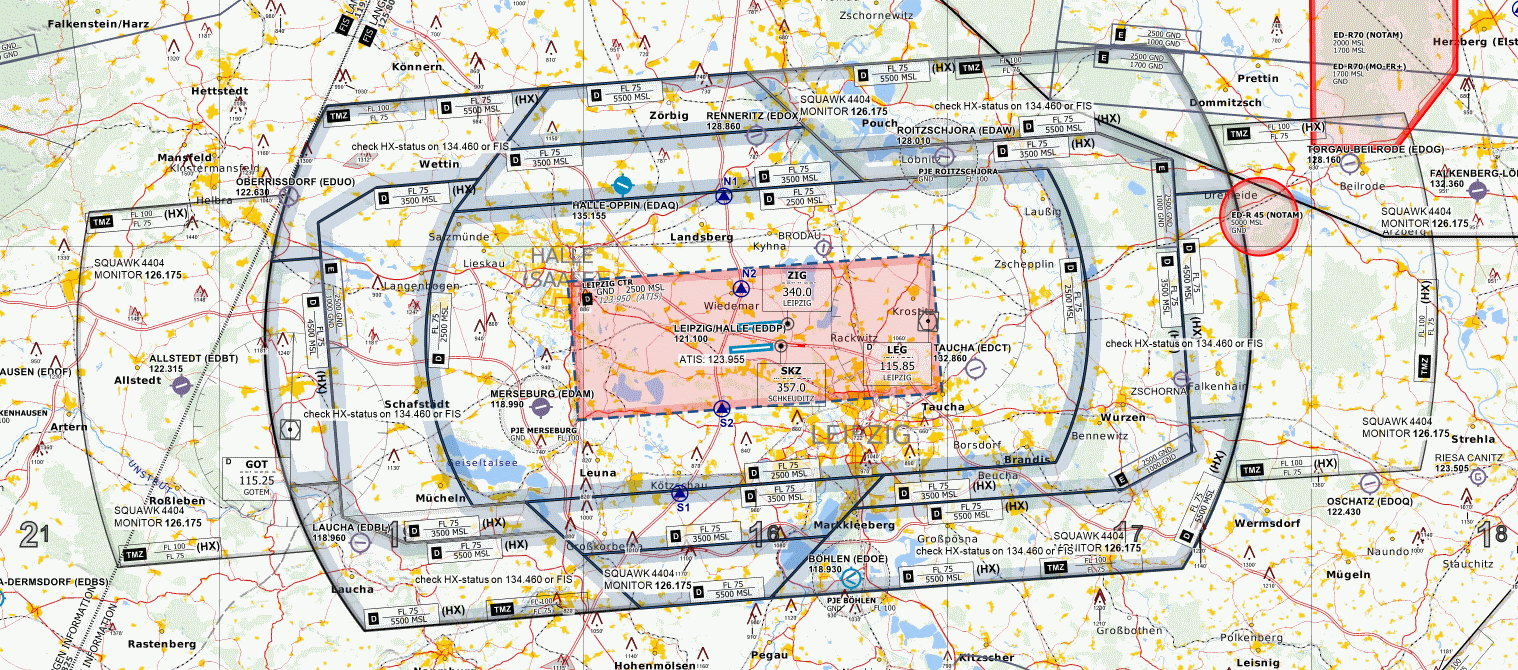 Airspace around EDDP. Source: Openflightmaps
Erfurt-Weimar (EDDE)
Erfurt-Weimar is surrounded by Airspace E, and TMZ(HX) Erfurt, activated for IFR traffic on demand. The TMZ code is 4410, and VFR traffic is expected to monitor 126.175 (EDDP_TRS_APP).
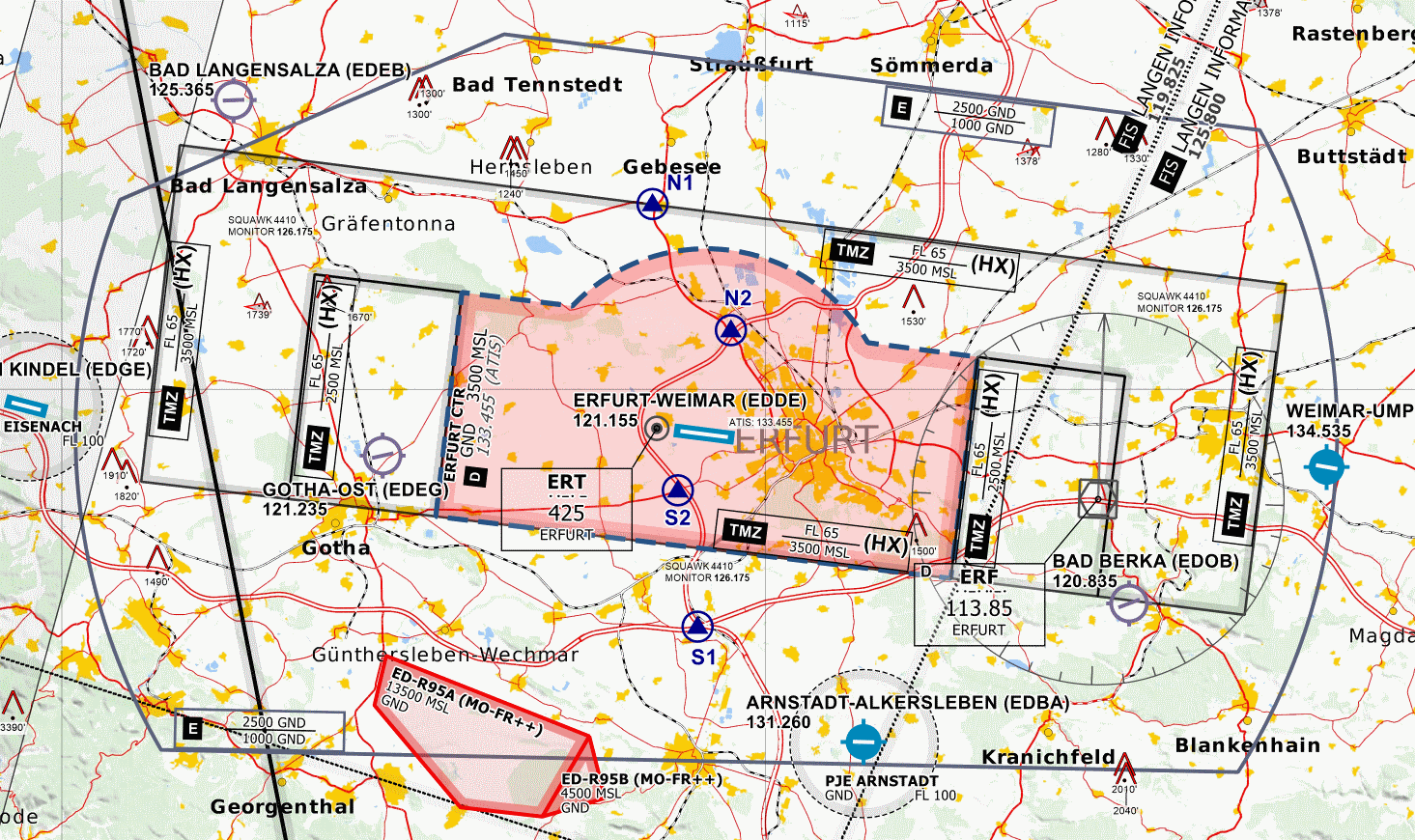 Airspace around EDDE. Source: Openflightmaps
Departing traffic
Leipzig/Halle
Traffic is handed off to München Radar in their first procedure turn (SID or OID), when proper separation is established.
The speed limit for Airspace D (250 kts) shall not be cancelled.
Departing aircraft may always be cleared to the last waypoint of the SID. Particular attention should be paid to potential conflicts in SAS airspace.
Handover Agreements
Refer to the EDMM LOP and EDMM-EDWW LoA, both available in ATCISS, for handover agreements.
Arriving traffic
RNAV-capable traffic arrives via the arrival fixes KOJEC, LUXBO, GOXLI, and YAWOY. Non-RNAV traffic will likely file to a nearby VOR (GOT, LEG). As non-RNAV arrivals are no longer available, the respective traffic should be provided with radar vectors to final.
If Bremen Radar is not staffed, Thüringen shall monitor the airspace for KOJEC arrivals and ensure they do not enter the overlying EDMM ACC sectors.
The speed limit for Airspace D (250 kts) shall not be cancelled; approaching aircraft shall always be guided in protected airspace (TMZ or Airspace C/D) during daytime.
Noise Abatement (2200–0600 lcl): Traffic shall be kept clear of the cities Leipzig and Halle whenever possible. The GOXLI and YAWOY procedures are designed to avoid overflights over the city of Leipzig, exercise care when instructing a direct.
Approach paths
Incoming traffic via KOJEC and GOXLI is to be issued with STAR clearance by Thüringen, traffic via YAWOY and LUXBO receive STAR clearance from SAS: Aircraft should expect FL110 at KOJEC, LUXBO, GOXLI and YAWOY.
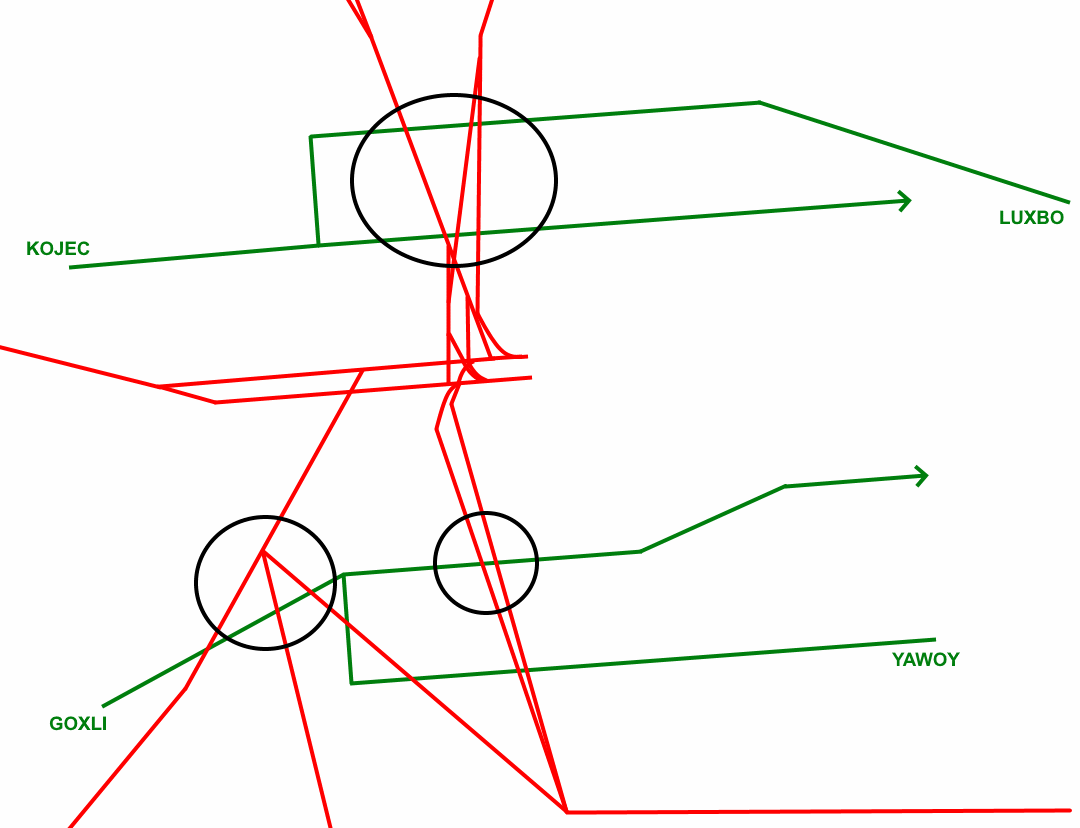
Arriving and departing traffic will cross in most cases, requiring attention to ensure separation. As an example, during 26 operations, SIDs and STARs cross as follows:
The following altitudes are recommended on the STARs:
| Position | Altitude |
| STAR Fix | FL110 |
| Upwind | FL100 |
| Downwind before mid-field | FL080 |
| Downwind after mid-field | 5000ft |
Approach types
Leipzig has ILS, LOC, and RNP approaches to all runways. The default approach (that is also broadcast in the ATIS) is the ILS Z approach, with RNAV-based guidance and missed approach procedures.
Visual approaches must be announced to Tower.
Noise Abatement (2200–0600 lcl): At night, establish is to be established on at least 11 NM finals for noise protection reasons (26: DP447/DP437, 08: DP442/DP432).
Operating mode
The default operating mode is Dependent Parallel Approaches on both runways.
The general requirements for DPA operations can be found here.
Specifically in EDDP, lateral separation can be reduced to 1.5 NM only once all involved aircraft have passed the IAF (JOGGA, SAHNU, MOWOX, LOFTO) and are established on the localizer/final track.
Required approach types: ILS or RNP.
LVP TODO
Runway assignment
- Aircraft via KOJEC, LUXBO can expect the northern runway
- Aircraft via GOXLI, YAWOY can expect the southern runway
- Aircraft parked on aprons 1 and 3 can expect the northern runway
- If traffic conditions permit, cargo aircraft land on the southern runway
- Aircraft types A346/B77W/B744/B748/A388 should be assigned to the southern runway
Depending on the traffic situation, deviations from these specifications are possible. However, the Arrival controller determines the runway to be used by aircraft in all cases. During high-traffic operations, it is recommended to send more aircraft to the northern runway, as the southern runway is heavily congested with departures due to cargo traffic.
Handover to Leipzig Arrival
The handover to Leipzig Arrival normally takes place at a speed of 220 kts. If traffic conditions permit or require, aircraft may also be handed over at a higher or lower speed.
Traffic on the downwind leg is normally handed over as shown below:
| Downwind | RWY 08 | RWY 26 |
| North | 5000ft | 4000ft |
| South | 4000ft | 5000ft |
Individual direct approaches can also be coordinated with Leipzig Arrival.
RECAT-EU procedures
RECAT-EU can be applied in Leipzig. Separation of traffic pairs Lower Heavy preceding and Lower or Upper Heavy succeeding require only 3 NM wake-turbulence separation.
|
Upper Heavy |
Lower Heavy |
| A330 | A300 |
| A340 | A310 |
| A350 | B703 |
| B747 | B757 |
| B777 | B767 |
| B787 | B783 |
| IL96 | C135 |
| DC10 | |
| DC85 | |
| IL76 | |
| MD11 | |
| TU22 | |
| TU95 |
Pilots can refuse this procedure at any time, but are expected to inform ATC early.
Erfurt-Weimar (EDDE)
STAR clearance given by TRS, otherwise vectors to final. Take note of the MVA when vectoring as well as VFR traffic in the Erfurt TMZ area. TMZ Erfurt activation is announced on the EDDE ATIS and should be done when IFR traffic is expected.
ILS 27 is CAT IIIb certified and must be used during low-visbility operations.
Areas of shared interest and Coordination
TRN shall notify FLG, DBAS, BOR and HRZ of any change of RWY direction at EDDP.
Holzdorf
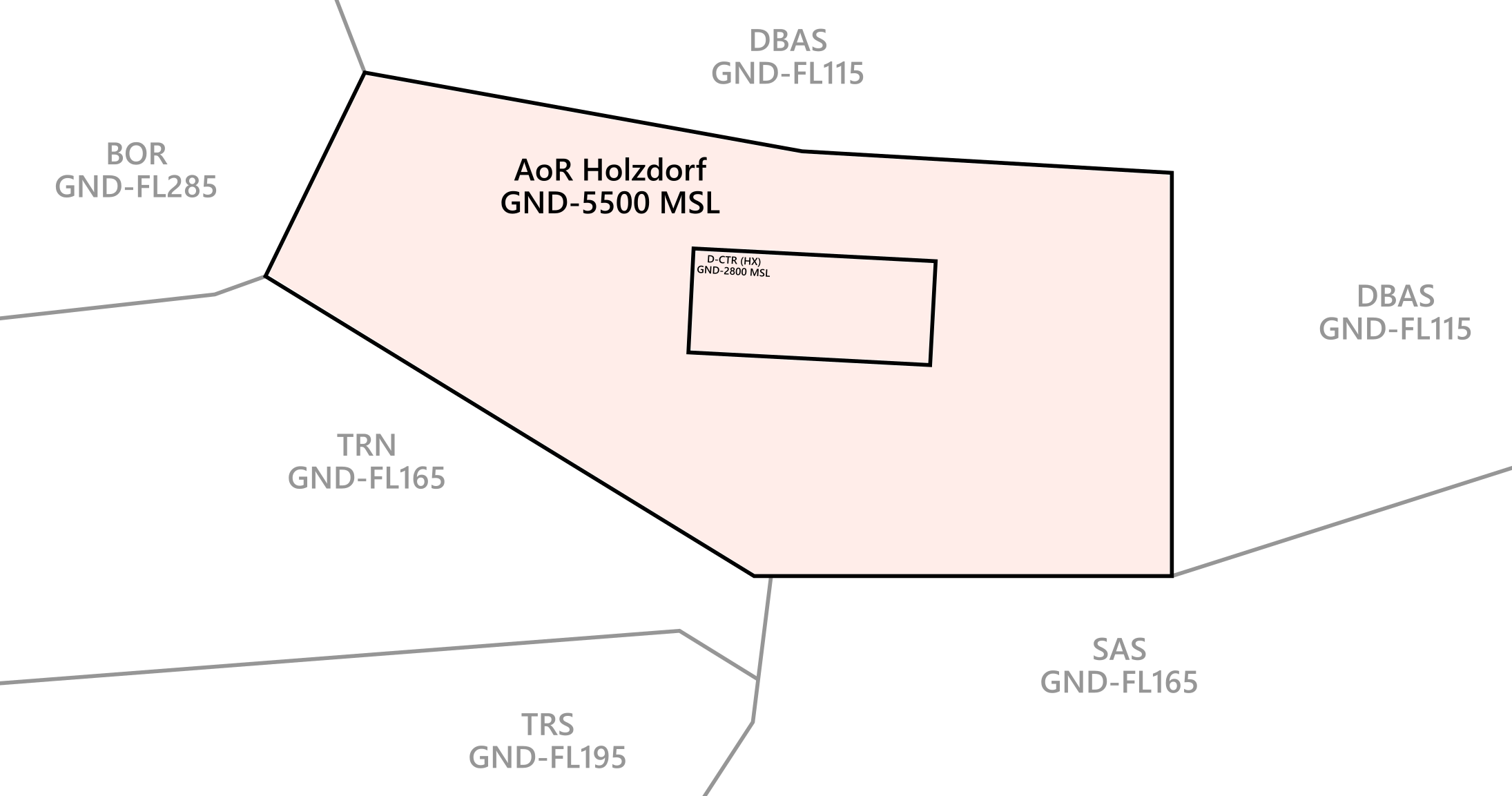
The Holzdorf military airfield has an area of responsibility in which Holzdorf Radar can control aircraft when activated. Berlin Arrival South is obliged to inform München Radar about the activation/deactivation of Holzdorf.
All aircraft to/from Holzdorf must be individually coordinated between Bremen Radar/München Radar and Holzdorf Radar.
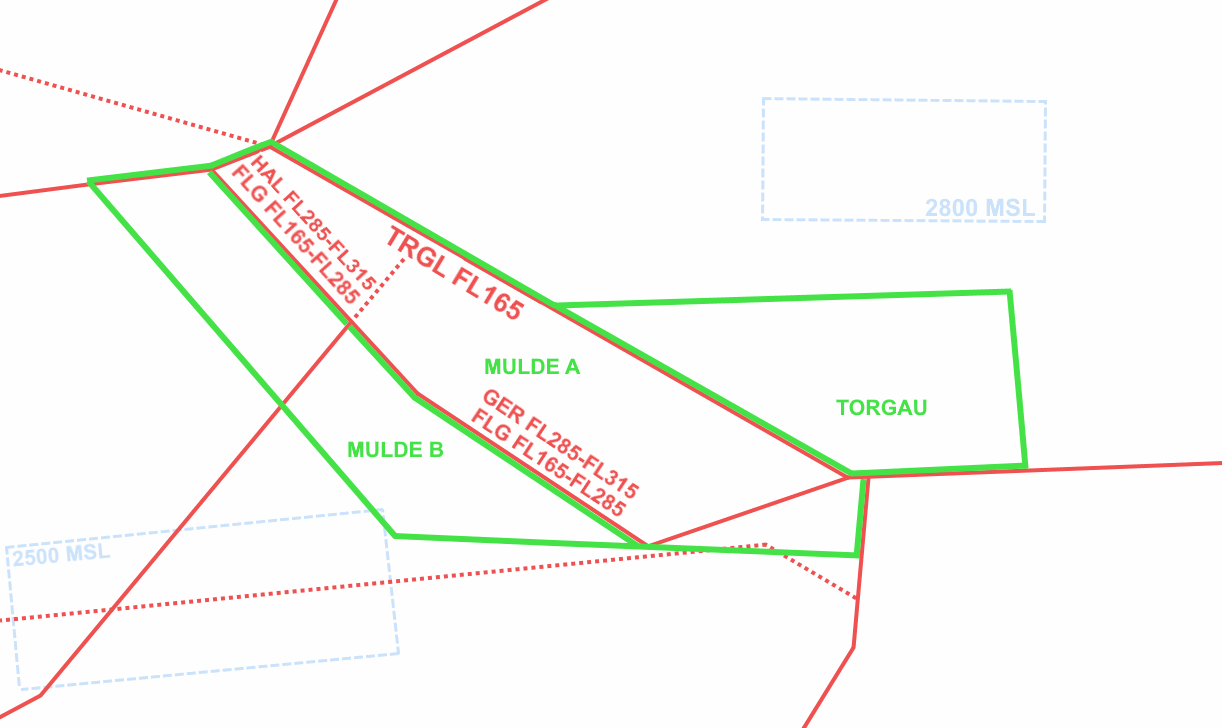
TORGAU Area
- GND – FL105 (when Holzdorf AoR active: 5500 MSL – FL105)
- Delegation on request by TRN to DBAS
- Only EDDP Inbound RWY 26
MULDE A Area
- FL135 – FL165/FL195
- Delegation on request by FLG to TRN/S
- For EDDB TMA Inbounds (earlier descent possible)
MULDE B Area
- FL165 – FL195
- Delegation on request by FLG to TRN/S
- For EDDB TMA Inbounds (earlier descent possible)