
Tower
Tower positions
In Leipzig there are the following two Tower positions:
| Station ID | Login |
Frequency |
|
| Tower North |
PTN |
EDDP_N_TWR |
125.955 |
| Tower South (primary) |
PTS |
EDDP_S_TWR |
121.105 |
If both Tower positions are staffed, the CTR is split in half in the middle, parallel to the runways. The north tower is responsible for the northern half of the CTR, the south tower for the southern half.
If only one tower is staffed, it also takes over the duties of the other tower and cross couples both frequencies.
Departing traffic
Leipzig Tower receives all departing aircraft from Leipzig Ground latest at the holding point.
As theyboth north- and southbound SIDs are airborneused theyfrom haveboth runways, the procedures will cross in the departure sector. To ensure separation, departure releases are required if the two Tower positions are worked by different controllers:
- S_TWR is required to
beobtain a departure release for ORTAG, and PENEM departures, - N_TWR is required to obtain a departure release for NEVKO, GOLAT, and DRN departures.
Traffic is handed over manuallyoff to München Radar on the correspondingcharted departure frequency:frequencies:
| 126.065 | 126.175 |
| PENEM ORTAG |
NEVKO |
| |
|
ThereIf there is an exception forno parallel departuresdeparture (lateral distance less thanwithin 3 NM), whereNM, the handoverhand-off onlycan takesbe placemade aswhen soonthe asaircraft oneis airborne.
Otherwise, the rules of theIndependent departuresParallel turnsDepartures away from the extended centerline.
apply:
ParallelIndependent parallel departures
To use independent parallel departuresdepartures, the following criteria must be met:
- All aircraft are flying a published departure procedure
ItAmustcrossingbe ensured thatof the flown departureroutesproceduresdowill notcross!happenCoordination(evaluationwithandthedepartureotherrelease)- The tower
isnecessary! Leipzig Towercontroller(s) must ensure that all involved aircraft do not turn before the published turns in the departure procedure. If one aircraft deviates from the extended centerline before the published turn, it and all other aircraft, that are closer than3NM3 NM have to be turned away from the extended centerlineimmediately!immediately- Both aircraft are handed over to the departure frequency once one of them turns away from the extended centerline
(or the radar seperation is given)as published in the departure procedure.
It is possible that aircraft with a good climb performance reach theirn initial climb (FL70) before one of them turns away from the extended centerline. To prevent an aircraft from levelling out, you can request a higher level from the responsible approach controller.
S_TWR always needs a release from N_TWR for departures to the north (ORTAG, PENEM)
N_TWR always needs a release from S_TWR for departures to the south (NEVKO, GOLAT, DRN)
Arriving traffic
Leipzig Tower receives all arriving aircraft one of the published approach procedures unless otherwise coordinated (e.g. visual approach). When the aircrafttraffic vacates the runway, they must beare handed overoff to theLeipzig ground controller.
Ground
RECAT-EU procedures
LeipzigRECAT-EU iscan onebe applied in Leipzig. Separation of thetraffic airportspairs at which the DFS approved the use of the RECAT-EU procedures.
The use of them is only allowed for the category "Lower Heavy/Upper Heavy" and "Lower Heavy/Lower Heavy", these are the aircraft types:
| Lower Heavy preceding and Lower or Upper Heavy succeedingrequire | only
According toSee the procedurerelevant 2section ofin the aboveApproach aircraftSOP typesfor only have to be separated 3NM (wake turbulence) unless another method of separation (e.g. radar separation) requires more. details.
The pilot can refuse this procedure at any time, but shall inform you early.
Caution between Upper-Heavy and Lower-Heavy! The "Lower Heavy" must be preceding! Mediums are excluded from this procedure!
Fore more information: Eurocontrol
Modes of Operation
Dependent Parallel Approaches are in operation default, with a minimum diagonal Leipzig is authorised for the useseparation of the1,5 following types of separation between aircraft on different finals:
Independent parallel approaches
When using independent parallel approaches both finals are completely independent.
To use parallel independent approaches, the following criteria must be met:
Both Tower and Director positions must be staffedAll aircraft involved must use precision approaches (the only precision approach that is available in Leipzig is the ILS approach)If an aircraft deviates from the final approach path, it and any other aircraft on the adjacent approach that is closer than 3NM from the deviating aircraft must be turned away from the final approach path immediately even if they are below the MVA!
Consider independent operations and ensure separation
Dependent parallel approaches
When using dependent parallel approaches 2 aircraft on different finals must be seperated at least 1,5NM. If the separation becomes less than 1,5NM it counts as a loss of separation which has to be resolved immediately.
To use parallel dependent approaches, the following criteria must be met:
At least one Director position must be staffedAll aircraft involved must use precision approaches (the only precision approach that is available in Leipzig is the ILS approach)If an aircraft deviates from the final approach path, it and any other aircraft on the adjacent approach that is closer than 3NM from the deviating aircraft must be turned away from the final approach path immediately even if they are below the MVA!
Staggered approaches
When using staggered approaches all aircraft under IFR on any approach have to be separated at least 3NM to any other aircraft under IFR on the adjacent approach
Segregated parallel operations
When using segregated parallel operations one runway is used exclusively for arrivals and the other one exclusively for departures. This mode of operation decreases the amount of traffic that can be handled and thus might seem unnecessary. If it is used during LVP it actually makes sense and increases the amount of traffic that can be handled.
Staggered approaches are preferred, but there is no reason not to use other modes of operation if the required criteria are met!
NM.
Preferred operating direction
The preferred operating direction is 26 up to a tailwind component of 5 knots. High-altitudeWinds windsat must3000–5000 ft are also be taken into observation.
when deciding.
Control zone
The Leipzig control zone extends roughly between the cities of Halle and Leipzig. The vertical limit of the CTR is 2500ft MSL. Entry and exit into the control zone is via the mandatory reporting points:
- North: November 1/2
- South: Sierra 1/2
Traffic circuits shouldare not be authorised between the runways.
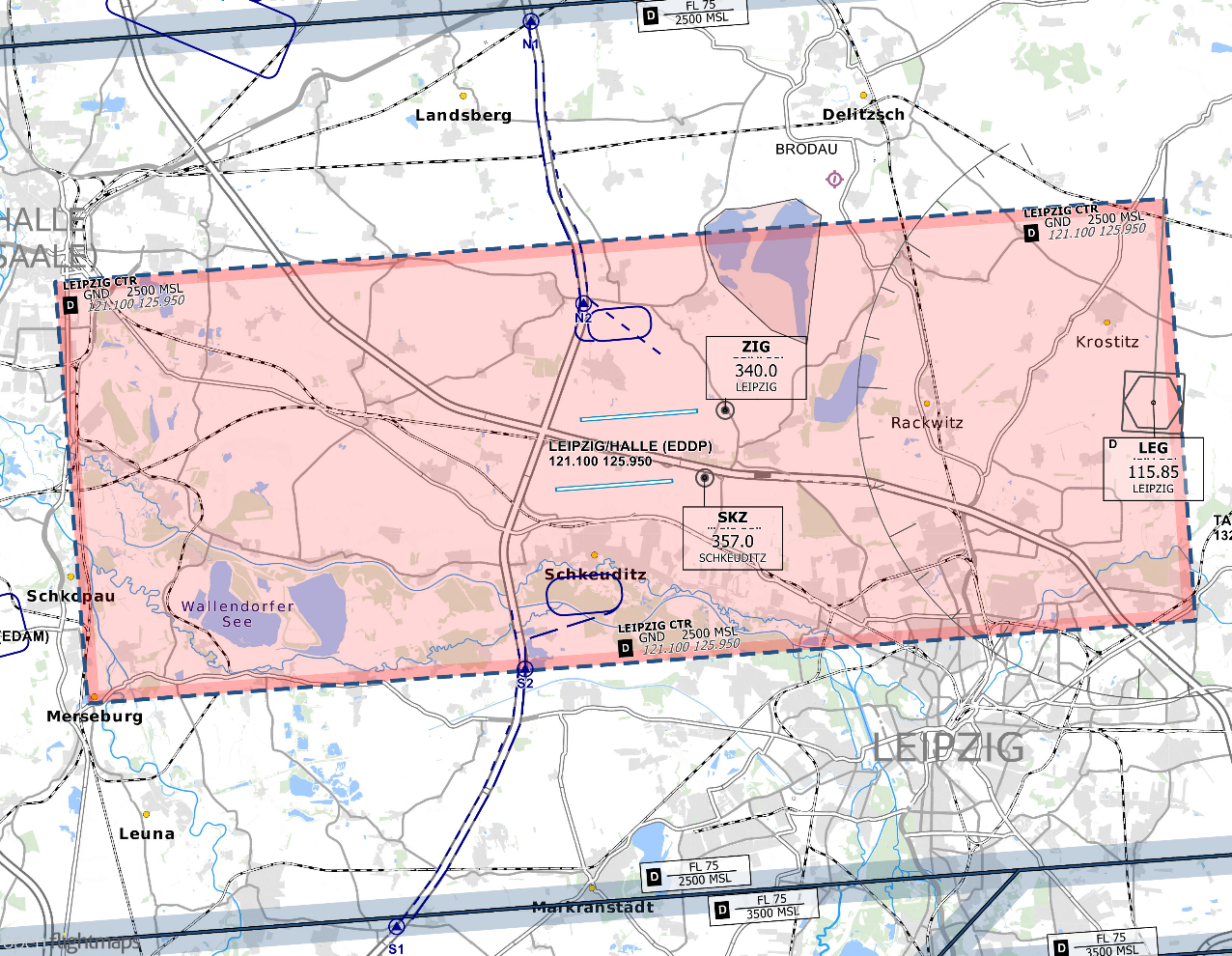 Controllzone Leipzig - © openflightmaps.org
Handovers between the towers should take place between the runways. A transfer point (e. g. circling) would be the tower.
High Intensity Runway Operations (HIRO)
HIRO
Due to the higher traffic volume at night, pilots are expected to vacate the runway between 2200lcl and 0600lcl via the following high-speed taxiways:
| Aircraft type |
Runway 08R | Runway 26L | |||
|
B752 / A306 / B763 ALL MEDIUM (Jet and Prop) |
S6 (2550m/7382ft) | S4 (1850m/6070ft) |
Aircraft parked at Apron 4/5 cross taxiway T and shall hold short of V.
Low Visibility Procedures (LVP)
In Leipzig, the ILS is authorised for all runways up to CATIIIb.
During low-visibility operations, single-use of runway OPS shall be used (egregated parallel operations); individual approaches may deviate from this.
To broadcast the information via ATIS that LVP are active, the ATIS maker URL is supplemented by "&lvp", which appears in the ATIS:
LOW VISIBILITY PROCEDURES IN OPERATION CAT II AND III AVAILABLE
Scenery problems
In the flight simulators, there are sometimes differences in the various sceneries compared to the Euroscope ground layout. The biggest problem here is the old southern runway, which is still present in the FSX default scenery. It runs parallel to taxiway N between H1 and H5. Furthermore, the old southern runway minimally intersects the new runway. In such cases, you should assign the north runway to the pilots, as this is displayed correctly in all simulators.