
S2 Training (TWR)
General
The S2 training in the FIR Langen takes place at the following airports. We hereby differentiate between Tier 1 and unrestricted airports:
| Tier 1 | Unrestricted |
| EDDF, EDDL, EDDK |
EDDS, EDSB, EDLW |
To start your trainingS2 at a Tier 1 airport,training, you must apply for a S2 rating course at our training system.
YourThe waiting times for Tier 1 airports are usually a bit longer and the training is more difficult and complex. However, after passing the exam, you can immediately control at ayour Tier 1 training airport. On the other hand, when you pass your exam at an unrestricted airport, you have to apply for any Tier 1 airport startswaiting withlist some apron/ground sessions. This level of training is accompanied by a Moodle course and is mainly self-study. It is important thatif you not only read the documents but also understand and learn the content. While studying ask other controllers, research and observe on frequency. If a training reveals that you do not meet the requirements, the training can be canceled immediately.
If you choosewish to docontrol your training at an unrestricted airport, you will start active training from the Tower Introduction. there.
The training on Vatsim requires a high level of self-study, self-reflection and commitment.
For Tier 1 airports, you must have controlled at least 2 months and 20 hours with your Apron/Ground endorsement before you will continue with tower training. The tower training consists of several sim sessions as well as online trainings.
Once your mentor gives you the go-ahead to control by yourself, you will be given a 30-day solo clearance. At the end of the solo phase, further advanced sim sessions and / or online trainings will be conducted. If you complete these successfully, you will be granted a further 30-day solo clearance, at the end of which the CPT will take place.
If you fail the exam on your first attempt, you will have another 30 days of Solo Phase to prepare for the retake.
If you have not received your rating at the end of the 90 days, the training will be paused for 1 year.
We expect you to use your training efficiently because it requires a lot of mentoring hours. If we have the impression that you are not using the solo phases and/or trainings for your learning progress and you are showing little to no activity, we reserve the right to withdraw the solo or even your training position at any time. Exceptions may be made in agreement with the lead mentor.
Requirements to start the training
- You are on the training system waiting list for the S2 training
- You have controlled at least 10 hours within the last two months at the S1 minor airports of the Langen FIR
- Waiting lists are usually processed on a "first-come, first-served" basis. However, minor exceptions are possible, e.g. due to trainees / mentors availability or exceptionally active trainees.
Training types and abbreviations
Every training will take place on our Teamspeak server in the channel "Training".
PEWMoodle(Positionseinweisung)courses / CBTs::AtDuringtheabeginning"PEW"of your training, youwillhavegettoallcomplete some self-study learning courses via thenecessaryVATGERinformationmoodleforwebsite.controllingItatconsiststheofcorrespondinglearningairport.materialThisbutcontainsalsolocalCBTsprocedures(computerandbasedspecialtiestests),only. As this is justso theoreticalknowledge,examsitwhichwillyoumosthavelikelytobe combined with a Sim-Session. If available, this step can be a Moodle course and online test.
pass- Sim session: Vatsim hosts a so called "sweatbox" server where sim sessions can be run. This has nothing to do with the live traffic on the network and is used for training special situations or making the first steps at bigger airports. The aircrafts are controlled by a mentor and the "radio transmissions" are done via TeamSpeak.
- OTS (Over-the-shoulder) training: During an OTS you will control a station on the live network. A mentor will always be by your side to help you, answer you questions and take over the station if necessary.
- Ground checkout: A special type of Ground OTS used at Tier 1 airports to check your competencies on the Ground. After passing this checkout, you will start your Tower training.
- Solo phase: The so called "Solo" allows you to control at our training airports without having the
requieredrequired rating. The Solo is limited in time and allows autonomous training before an exam. - VATEUD theory exam: The VATEUD theory exams are web-based multiple choice tests which you already know from the S1
(Minor)Training. They need to be passed before you receive yourCPT.first solo phase. The exam will be assigned to you by a mentor once you get your solo phase. You can find your assigned exams here. - CPT (Controller practical test): A CPT is a practical exam where you show an examiner and a local mentor what you have learned. After passing the CPT, you will receive the S2 raiting and, if applicable, your Tier 1 endorsement for your training airport.
After each training session, there will be a debriefing session where you and the mentor will discuss the session. The mentor will also tell you where you can improve and give you tips on how to do this. Of course, there will be time for you to ask any questions you may have had during the control. Finally, you will receive a training reportlog via the training system which summarizes the session.
Tip: You may and should listen to all kind of training sessions of other trainees. This is highly recommended and expected in all training phases, as the training sessions you actively attend will most likely not be sufficient on their own.
During your S2 training, you should focus controlling on your training airport. However, as preparation for the tower sessions, you should also practice on S1 minor airports - especially VFR traffic.
Training Steps
Since every airport has individual specialties and challenges, the standard training process varies strongly. Below, you can find the training schemes for the Tier 1 airports:
This is only an outline of the training steps to the S2-S2 CPT. As the personal speed of learning and progress varies greatly between trainees, there may be individual variations. There might be extra steps at certain airports due to the complexity.
Overview EDDF
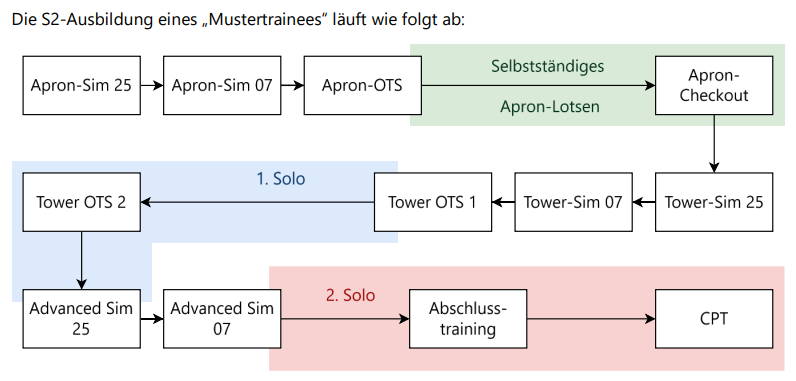
(S2
Overview VATEUDEDDL

Overview EDDK
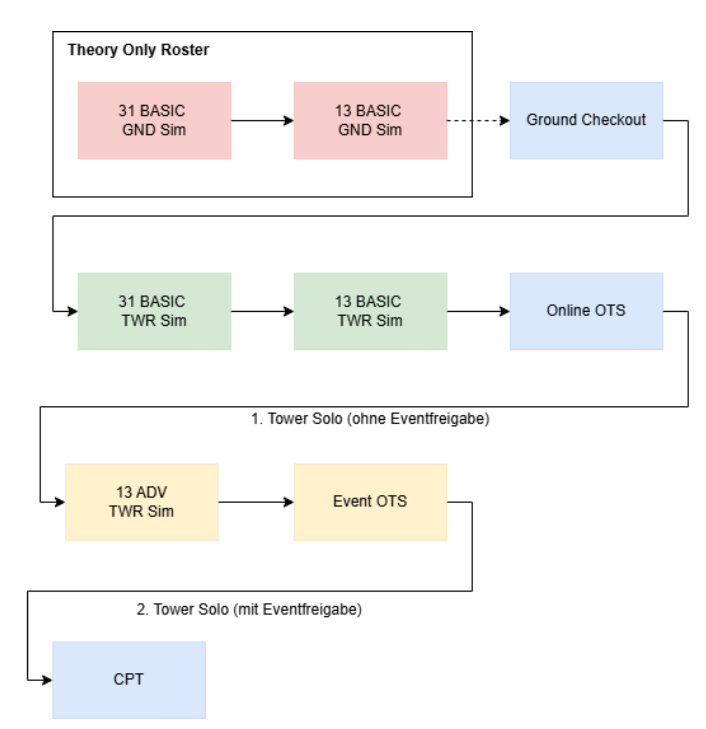
The training steps will now be explained in detail:
Moodle course
After you were enrolled in the S2 training course by your mentor, you have to complete at least one moodle course for your training airport. This course consists of the relevant learning material and at the end, also a CBT which you have to pass in order to start your practical training.
For unrestricted airports, you also have to complete the VATGER S2 training course already, as you directly start with tower training. For Tier 1 airports, this course has to be completed later, after the actual tower training has begun.
Ground Endorsementtraining (Tier 1 airports only)
Requirements
You have
controlledcompleted all necessary moodle courses- EDDF/EDDL only: You have observed other apron controllers at your airport at least
101hourshourduringon theS1network,trainingfocussing especially on:- Correctly applying the SOPs (EDDF e.g. usage of TWYs L and N, handoff to correct tower frequencies)
- Setting
Youofhaveprioritiesapplied(early handoffs, no unncessary delay, moving before standing) - Frequency management (multi-tasking, giving and labeling standbys, asking for
thereliefratingiftrainingfrequencyviaisthetootraining system IfConflictapplicable,detectionyouandpreparedmanagementavailable(earlyMoodleholdtrainingshortsstepsor give ways)You have controlled at least 10 hours within the last two months at the S1 training
Contents
Together with a mentor, you will go through the theory for yourthe endorsementGround & Delivery position and practice staffing the position during severalone or more simulation session.sessions and for EDDF/EDDL also at least one online session (OTS). Once your mentor is satisfied with your performance, you will receive your ground endorsement.endorsement (EDDF/EDDL only).
If the performance is well below average after multiple sessions, training may continue at an unrestricted airport.
Although it is not prohibited, we strongly recommend that you only control at your training airport. An exception to this is the preparation for the tower introduction. This can be practiced on an S1 tower shortly before.
Ground Checkout (Tier 1 airports only)
Requirements
You have controlled at least 20 hours on the ground endorsementEDDFEDDF/EDDL only: You have controlled at least 20 hours during the last 2 monthsatonFrankfurtthe Apron / Ground
- A mentor has contacted you regarding your checkout
- You have booked the station with Training=Yes as soon as the training date is confirmed. If there is a booking conflict, contact your mentor
Contents
In this checkout, you show oneyour mentor that you can apply the skills you have learned on ground.Ground / Delivery. To do this, you occupy the position for at least 1 hour. This is followed by a detailed debriefing.
If the checkout is rated positively, you will continue with the tower introductions as soon as there are training capacities.
The Checkout has to be done only on Tier 1 airports.
Tower Introductionintroduction sessions
Requirements
- A mentor has contacted you regarding your tower training
- You have completed and passed the chapter "Pisteneffizienz" in the Moodle course
Contents
AfterThe tower introduction sesisons consist usually of at least two sim sessions and one online training. Furthermore, the theorytheoretical lesson, the introductory session is held in two parts. Depending on the training airport, the theory and simulation sessionsknowledge may takebe placeorally onassessed theas samewell day.(S2 theory, SOP theory).
After successful introduction sessions, you willhave continueto yourcomplete towertheVATEUD training.theory Duringexam. your S1 solo phase (30 days in the standard case),Thereafter, you will controlget youra training30 airportdays onsolo your own and prepare for your CPT, which you will also complete there.
After 2 weeks, an OTS will be conducted to evaluate your performance so far. You should have controlled at least 10 hours by then.endorsement.
VATEUD Theory Exam
Requirements
- You are ready for your first solo phase
- You can find the exam here.
- If you have further questions about the contents of the VATEUD Theory exam, please contact one of the mentors, before you submit the exam
Contents
In the VATEUD theory exam, you will be asked about S2 (tower) knowledge but also VATSIM specific rules.
The VATEUD theory exam must be completed and passed before starting a CPT. Otherwise, the exam cannot take place!
Solo endorsement
During your S1 solo phase, you will control at your training airport on your own and prepare for your CPT.
The solo phase runs for only 30 days! Towards the end of these 30 days, you should have gained enough experience, also with larger traffic volumes, to be more or less prepared for a CPT.
After 2 weeks of your solo, an OTS will be conducted to evaluate your performance so far. You should have controlled at least 10 hours by then. At the end of your solo, one ore more advanced sim sessions (Tier 1 airports only) will be condcuted to test you on high traffic and challenging situations.
Finally, a second 30 days solo phase will be granted which should include the controller practical test (CPT) at the end.
OTS Training
Requirements
- You have controlled for at least 10 hours
- Your introduction was about 2 weeks ago
- A mentor has contacted you regarding your training
- You have booked the station with Training=Yes as soon as the training date is confirmed. If there is a booking conflict, contact your mentor
- You have completed and passed the chapters "Fortgeschrittene VFR Verfahren" and "Low visibility operations (LVO)" in the Moodle course
Contents
Together with a mentor, you control XXXX_TWRTower (and if traffic permits, all stations below) in the evening. The mentor checks if you are applying all procedures correctly and how you handle yourself online.
After another 2 weeks, you will do some advanced
Advanced sim sessions and(Tier another1 onlineairports training which is a kind of CPT preparation training.
CPT Preparation Trainingonly)
Requirements
- You have controlled at least 25 hours at your exam airport
- You have a good routine for dealing with "normal" traffic situations
- You have reviewed all theory you have learned throughout your training
- A mentor has contacted you regarding your training
Contents
Usually, two CPTadvanced preparationsim trainingssessions under high traffic volumes are conducted in the simulator.conducted. Take the opportunity to listen to other trainings!trainings as well!
If the mentor is satisfied with your performance and your theoretical knowledge, he will give you the "go" for your final training.
If you successfully complete the first CPT preparation training, you will be given a further solo phase of 30 days. During this phase, you will do a last online training followed by the CPT.
Final Trainingonline training
Requirements
- Your mentor has given you the "go" for the final training
- You have booked the station with Training=Yes as soon as the training date is confirmed. If there is a booking conflict, contact your mentor
Contents
You will occupy the examination station under the supervision of a mentor. GNDDepending andon DELthe aretraffic blocked, so this training shows ifsituation, you arewill readycontrol fortower top-down or get a relief (GND / DEL). This is your decision, just like during the CPT.exam!
The mentor might notice a few things that you could do better that didn't show up in the simulator.
If the mentor is satisfied with your performance, he will give you the "Go" for the CPT. He then makes an appointment with you and applies for your CPT.
CPT
Requirements
- Your mentor gave you the "Go" for the CPT.
- You have passed the VATEUD Theory Exam
- You have booked the station for a duration of 1 hour (times in UTC!)
- In the [STAFFING/BOOKING] Thread you have left a note that you want to do a CPT at that time.
- Your mentor or the Leading Mentor will request an examiner at the ATC Training Department. If your CPT can take place, you will see this in the thread Bestätigte Controller CPTs.
- All CPTs held on a day other than the weekly event must be
advertised.advertised (except EDDF). You can request your advertisement in the following thread: [CPT] Request für CPT-Werbung (The Leading Mentor/CoT has the final say on whether the CPT should be advertised). - Please organize a replacement yourself, e.g. by creating a thread in the forum section of the FIR Langen or by asking for it in the Staffing/Booking Thread.
Contents
During the CPT, you will demonstrate to two examiners (an ATD examiner and a local examiner) that you have mastered all ground positions. All tower and ground training content is relevant to the exam. YouDepending on the traffic situation, you will control your airporttower top-down,down butor we will give youget a relief station(GND / DEL). This is primarily your decision, so if you think a relief would be appropriate, tell it to the traffic load becomes overwhelming.examiners!
Tip: control safely and exactly the way you learned it. Don't try to control the traffic overly cautiously, nor do try to get out to all limits and beyond - the examiners only want to see that you can handle the traffic volume well and as confidently as possible. A perfect CPT is therefore very boring for the examiners to watch. If you should have a major mishap or it's just not your day at all, don't be too disappointed about a failed CPT - of course, you have (mostly after a new CPT preparation training) another try.
After passing the CPT, you will receive your S2 rating. By upgrading your rating to S2, you will be allowed to staff all unrestricted airports and, subject to your mentor's approval, your Tier 1 training airport. For other Tier 1 airports, you must undergoapply anfor introductionthe priorcorresponding towaiting controllinglist there.first.