
Flow Management Position (FMP) - Copy
General
Flow Management Position (FMP) describes a working position which is responsible for ensuring a constant flow within
Normally, on VATSIM, Langen operates under the principle of "free flow", meaning there are no restrictions on aircrafts´ movements, departures, or arrivals. However, during periods of high traffic, flow control may used. Flow control measures may be issued either by a local FMP, if one is present, or through a larger traffic management initiative like ECFMP (European Collaboration and Flow Management Project).
Setup
In Langen two different types of FMP Positions can be used. EDGG_A_FMP and EDGG_C_FMP. None of these positions have an own sector nor an own frequency:
- Langen profile "EDGG FIR - Coordinator.prf" shall be used
- Open the EDGG.asr
- Open AMAN (Arrival Manager) if needed -- (enter ".aman open" in the chat of Euroscope)
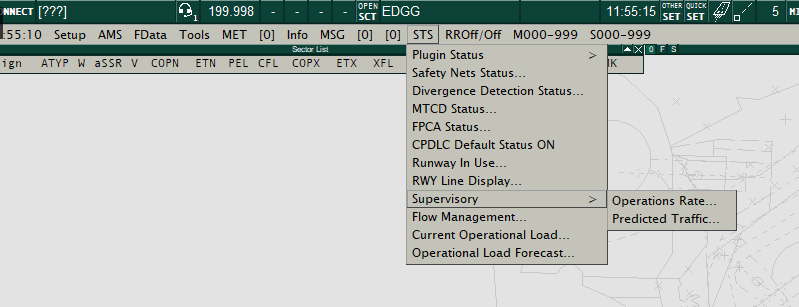
- Open the "Predicted Traffic" and "Operations Rate" via TopSky if neede
Predicted Traffic & Ops. Rate
Tasks
Various solutions are under consideration to ensure capacity is maximised in alignment with the traffic demand profile.
- Sector management
- Number of sectors
- Sector configurations and activations
- Holding pattern
- Balancing arrival / departure capacity
- Reduce traffic complexity
Air traffic flow management is structured into three successive phases: strategic planning, pre-tactical planning, and tactical operations.
Strategic planning involves measures that are normally implemented well in advance, often several months ahead and therefor not used on VATSIM. These measures are developed following consultations with air traffic control (ATC) service providers and aircraft operators. Typical examples include increasing ATC capacity, such as deploying controllers from another facility to manage seasonal or temporary traffic peaks. Another key measure is the rerouting of certain traffic flows, for example by restricting flights based on their departure point or destination. Within the European Union, such restrictions are defined in the Route Availability Document (RAD). Additionally, flights may be scheduled or rescheduled to balance traffic demand where appropriate. During this phase, the potential need for tactical ATFM measures is also identified.
Pre-tactical planning takes place one day in advance and can be regarded as a fine-tuning of the strategic measures. Detailed plans for the following day are published and made available to all concerned parties. Examples of pre-tactical measures include limited rerouting of specific traffic flows, which generally has less impact than strategic rerouting, coordination of off-load routes, and decisions on the use of tactical measures for the next day, as opposed to merely identifying the need during the strategic phase.
Tactical operations cover measures that take effect on the day of implementation. This phase focuses on executing the previously agreed actions and continuously monitoring the traffic situation to ensure the measures achieve the intended results. When traffic demand is expected to exceed the capacity of a particular sector or aerodrome, the ATC unit informs the ATFM (Air Traffic Flow Management/FMP) unit so that appropriate restrictions can be applied. Affected operators are also advised of any expected delays and restrictions.
What can be done?
- Rerouting Flows/Flights
- Advancing traffic
- FMP tactical measures
- Minimum Departure Intervals (MDI)
- Miles in Trail (MIT)
https://skybrary.aero/articles/flow-management-position-fmp
https://skybrary.aero/articles/air-traffic-flow-management-atfm
https://skybrary.aero/articles/atm-sector-management