
Flow Management Position (FMP)
General
Flow Management Position (FMP) describes a working position which is responsible for ensuring a constant flow within a FIR.
Normally, on VATSIM, Langen operates under the principle of "free flow", meaning there are no restrictions on aircrafts´ movements, departures, or arrivals. However, during periods of high traffic, flow control may used. Flow control measures may be issued either by a local FMP, if one is present, or through a larger traffic management initiative like ECFMP (European Collaboration and Flow Management Project).
Setup for EDGG
The primary login In Langen is EDGG_FMP with the option to add middle identifier (e.g. APP/CTR_FMP). FMP positions do not have an own sector nor an own frequency:
- EDGG FIR - Langen profile shall be used
- Open the EDGG.asr
- Open AMAN (Arrival Manager) if needed -- (enter ".aman open" in the chat of Euroscope)
- Open the "Predicted Traffic" and "Operations Rate" via TopSky if neede
Predicted Traffic & Ops. Rate
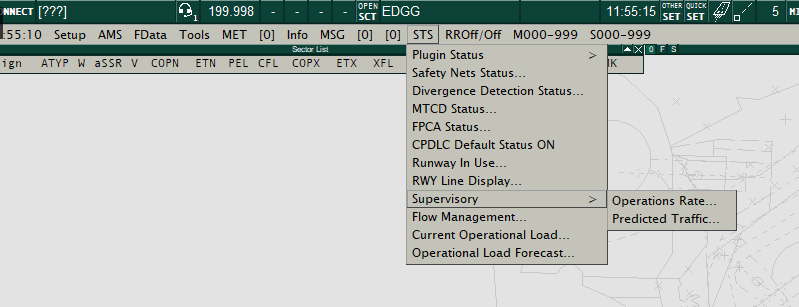
The setup will provide predefined Tag colors depending on the arrival airport.
- blue = Frankfurt
- green = Düsseldorf and Cologne
- black = all other
- grey = overflights
When VACS is used for coordination with adjacent stations, the "phone book" with the search bar should be used to find the sector.
Air Traffic Flow Management (ATFM) on VATSIM
A range of solutions is being considered to ensure that available capacity is used as efficiently as possible and aligned with the expected traffic demand profile.
The primary objectives of ATFM are to:
-
Match traffic demand with available ATC capacity
-
Maintain safe and orderly traffic flow
-
Reduce controller workload and traffic complexity
-
Ensure fair and predictable service for pilots
Key focus areas include:
-
Sector management and sectorisation
-
Number of active sectors and opening times
-
Sector configurations and handover procedures
-
Arrival and departure balancing
-
Use of holding patterns and spacing techniques
ATFM Phases on VATSIM
ATFM on VATSIM follows three conceptual phases: strategic planning, pre-tactical planning, and tactical operations. While these phases mirror real-world ATFM, their application is adapted to VATSIM constraints where tactical operations is the most imporatant part for the daily operations.
Tactical Operations:
Scope: Real-time traffic management
Responsibility: Active ATC units
Tactical operations are executed during live traffic situations and represent the most critical ATFM phase on VATSIM. Controllers must continuously assess traffic demand relative to their sector capacity.
When demand exceeds capacity, controllers may apply tactical measures to maintain safe operations.
Examples include:
-
Issuing holding instructions
-
Applying speed control and spacing
-
Delaying departures or clearances
-
Rerouting individual aircraft
-
Restricting entry into a sector temporarily
Effective coordination with adjacent sectors is essential to prevent overload and ensure smooth traffic flow.
ATFM Measures Available to VATSIM Controllers
Controllers may apply the following ATFM measures as appropriate:
Rerouting
-
Tactical rerouting of individual flights to reduce congestion
-
Use of predefined off-load or secondary routes during events
Traffic Advancement or Delay
-
Advancing departures when capacity allows
-
Delaying pushback or start-up clearance to manage demand
Minimum Departure Intervals (MDI)
-
Applying spacing between departures from the same aerodrome (seconds or minutes)
-
Used to protect arrival streams or downstream sector capacity
Miles-in-Trail (MIT)
-
Ensuring minimum longitudinal spacing between aircraft
-
Particularly useful for managing arrival sequences or sector entry rates
Holding Patterns
-
Use of published or tactical holding to absorb excess demand
-
Should be applied proportionally and communicated clearly to pilots