
Arrival - Thüringen Low
Sectorization
München Radar sectors Thüringen Low Nord and Thüringen Low Süd (EDDP_TRN/TRS_APP) are responsible for all arrivals and departures from/to Leipzig/Halle (EDDP) and Erfurt-Weimar (EDDE).
Additionally, the station EDDP_TRS_APP covers sector Sachsen Low (SAS), handling all movements at Dresden (EDDC).
Requirement for staffing the sectors is proficient knowledge of the SOPs for airports EDDP, EDDE and EDDC, as top-down service shall be provided at those airports. Besides those controlled airports, the uncontrolled airfield Leipzig-Altenburg (EDAC) lays within the sector, offering IFR procedures and is therefore sorrounded by a RMZ.
It is possible to staff two additional stations within Leipzig TMA for delegating Director tasks to separate stations: Leipzig Arrival Nord/Süd (EDDP_ND/SD_APP) which do not hold a sector themselves but receive a full release for traffic being sent to them.
The sector dimensions and divisions for the approach sectors underlying EBG Ost are shown in this chart:
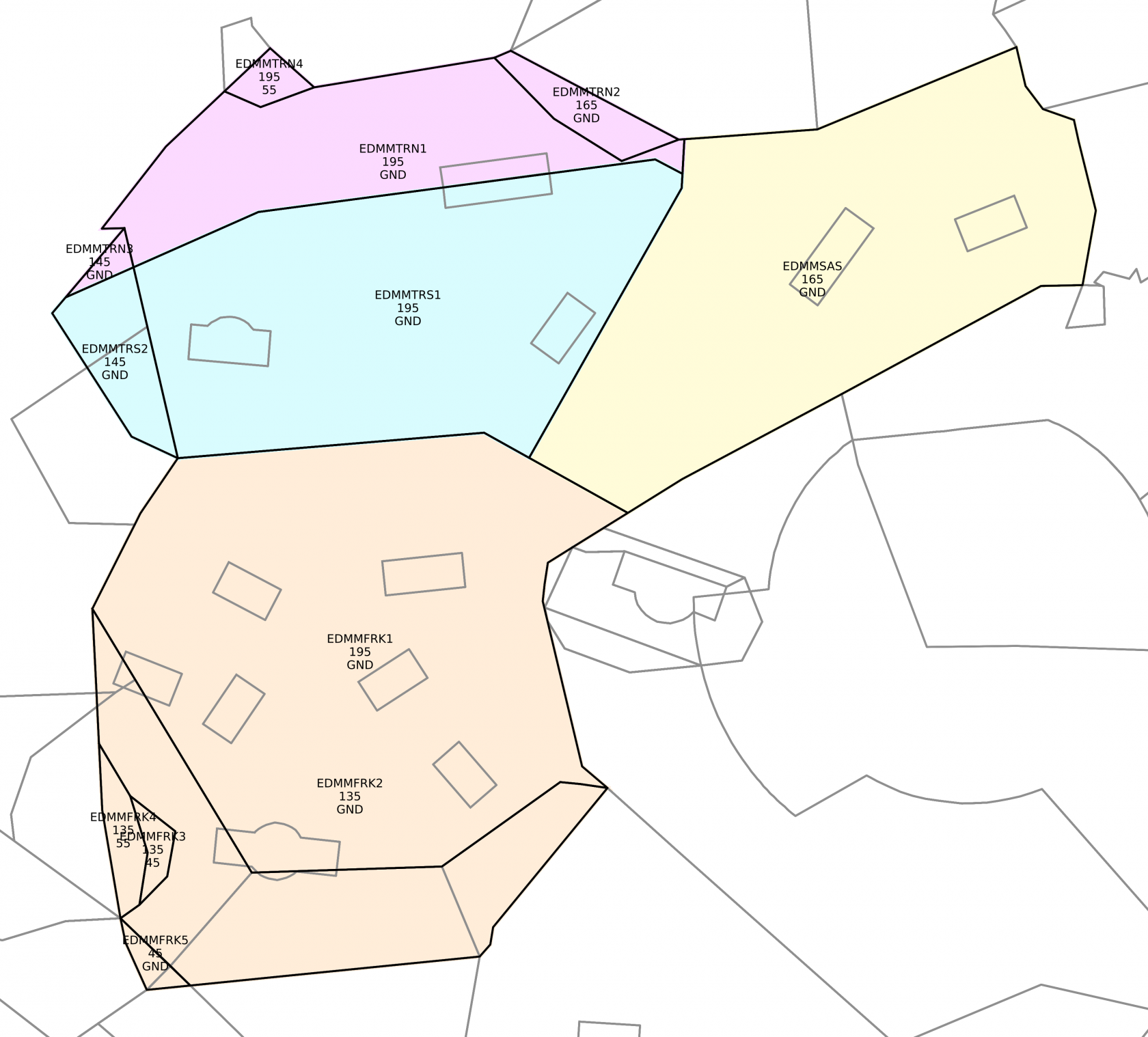
Approach sectors underlying EBG Ost
Airspace
Leipzig/Halle (EDDP)
Around Leipzig/Halle, Airspace D (non-CTR) is established up to FL75. Between FL75 and FL100, in the Airspace E band, an additional TMZ is established. VFR traffic is expected to squawk 4404 and monitor 126.175 (EDDP_TRS_APP).
Both Airspace D and the TMZ Leipzig consist of always-active parts, and HX parts that are active depending on the operating direction (26 – east active, 08 – west active).
IFR traffic should be kept within protected airspace during daytime. Speed restrictions of Airspace D (≤250 kt) may not be lifted.
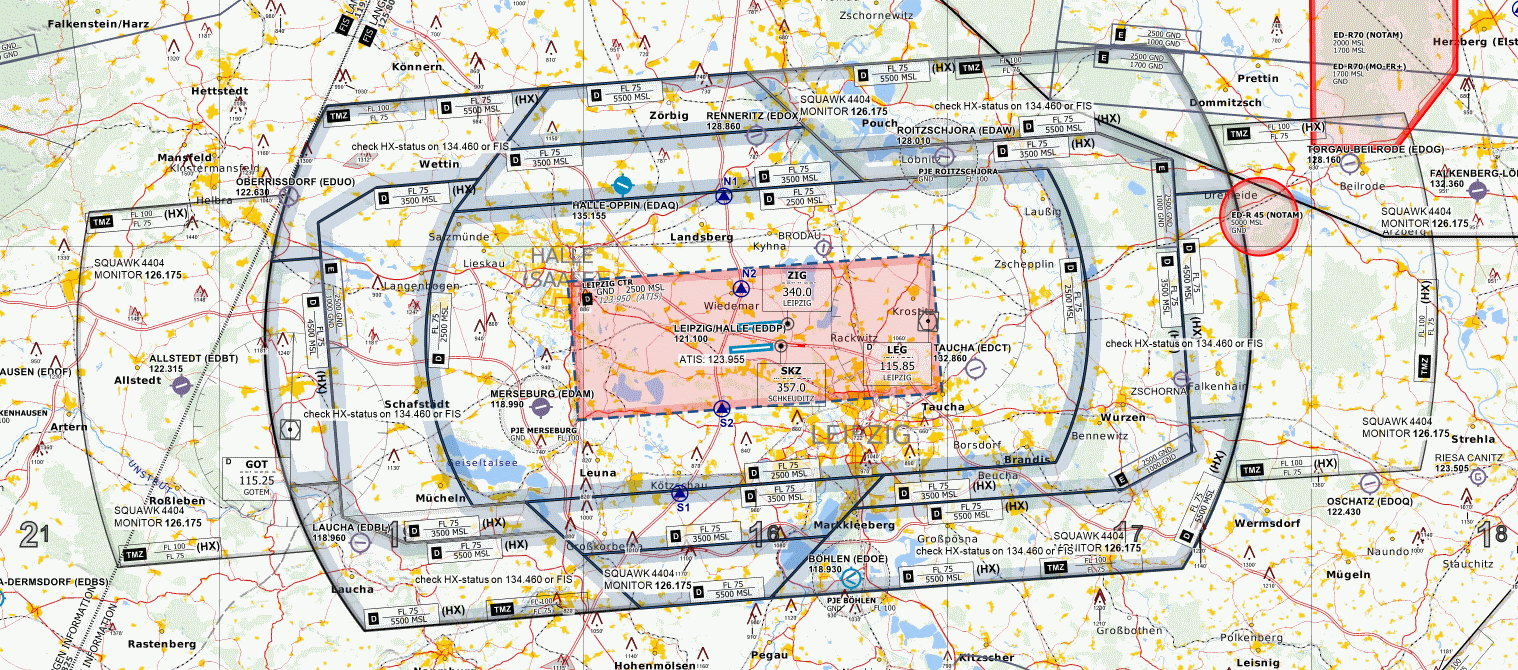 Airspace around EDDP. Source: Openflightmaps
Erfurt-Weimar (EDDE)
Erfurt-Weimar is surrounded by Airspace E, and TMZ(HX) Erfurt, activated for IFR traffic on demand. The TMZ code is 4410, and VFR traffic is expected to monitor 126.175 (EDDP_TRS_APP).
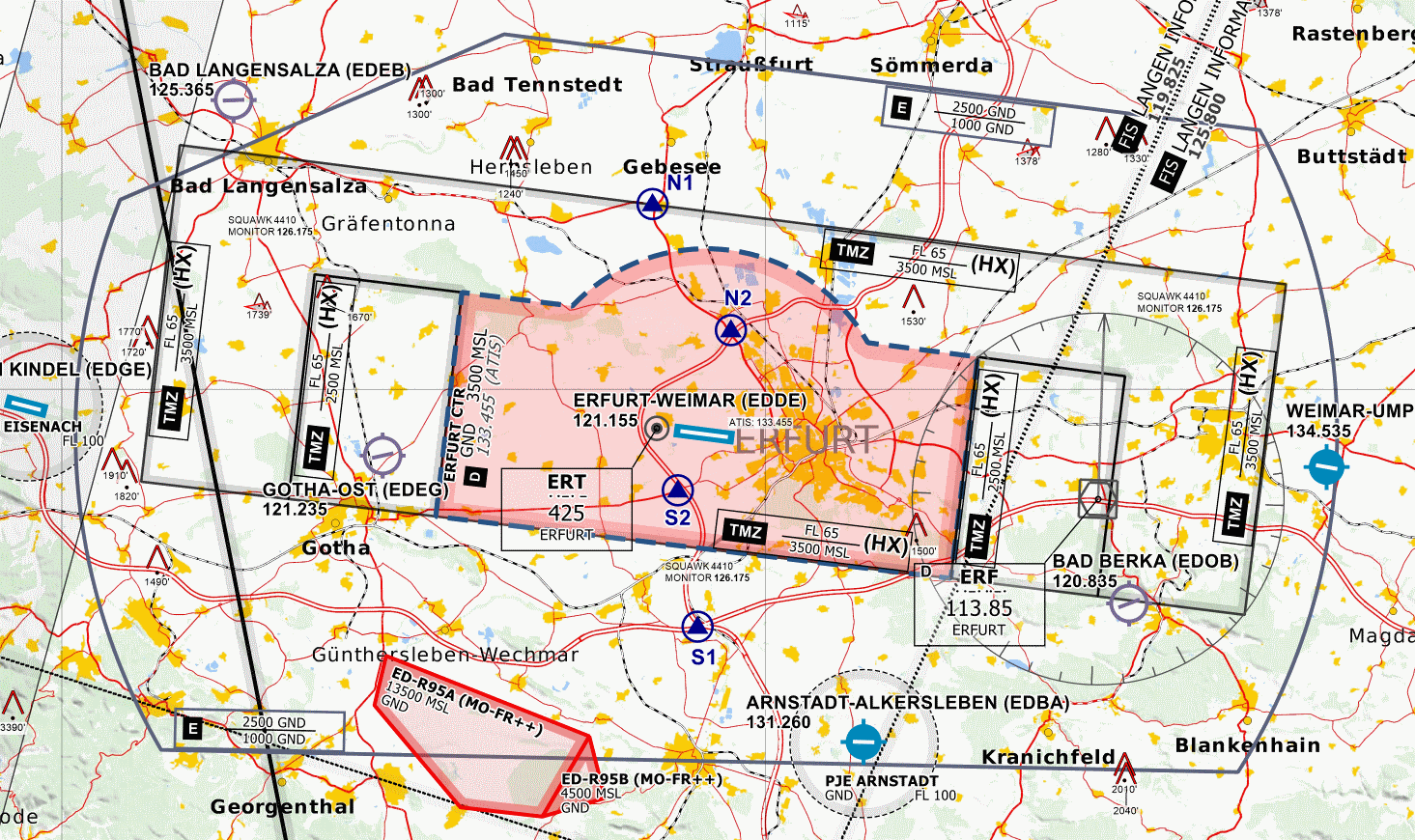 Airspace around EDDE. Source: Openflightmaps
Departing traffic
Leipzig/Halle
Traffic is handed off to München Radar in their first procedure turn (SID or OID), when proper separation is established.
The speed limit for Airspace D (250 kts) shall not be cancelled.
Departing aircraft may always be cleared to the last waypoint of the SID. Particular attention should be paid to potential conflicts in the Sachsen Low.
Handover Agreements
Refer to the relevant LOP/LoA documents, or ATCISS for handover agreements.
Arriving traffic
RNAV-capable traffic arrives via the arrival fixes KOJEC, LUXBO, GOXLI, and YAWOY; non-RNAV via GOT. It is recommended to vector non-RNAV traffic to final, as the GOT procedures conflict with other traffic.
If Bremen Radar is not staffed, Thüringen shall monitor the airspace for KOJEC arrivals and ensure they do not enter the overlying EDMM ACC sectors.
The speed limit for Airspace D (250 kts) shall not be cancelled; approaching aircraft shall always be guided in protected airspace (TMZ or Airspace C/D).
Approach paths
Incoming traffic via KOJEC and GOXLI is not cleared for the respective STAR by ACC, and is therefore to be issued with an appropriate STAR clearance. Incoming aircraft via YAWOY and LUXBO are already cleared for a STAR by Sachsen Low (EDDC_SAS_APP). For better planning, aircraft should expect FL110 at KOJEC, LUXBO, GOXLI and YAWOY. The course of the arrival routes is also important, as they conflict with departure routes to the south and north.
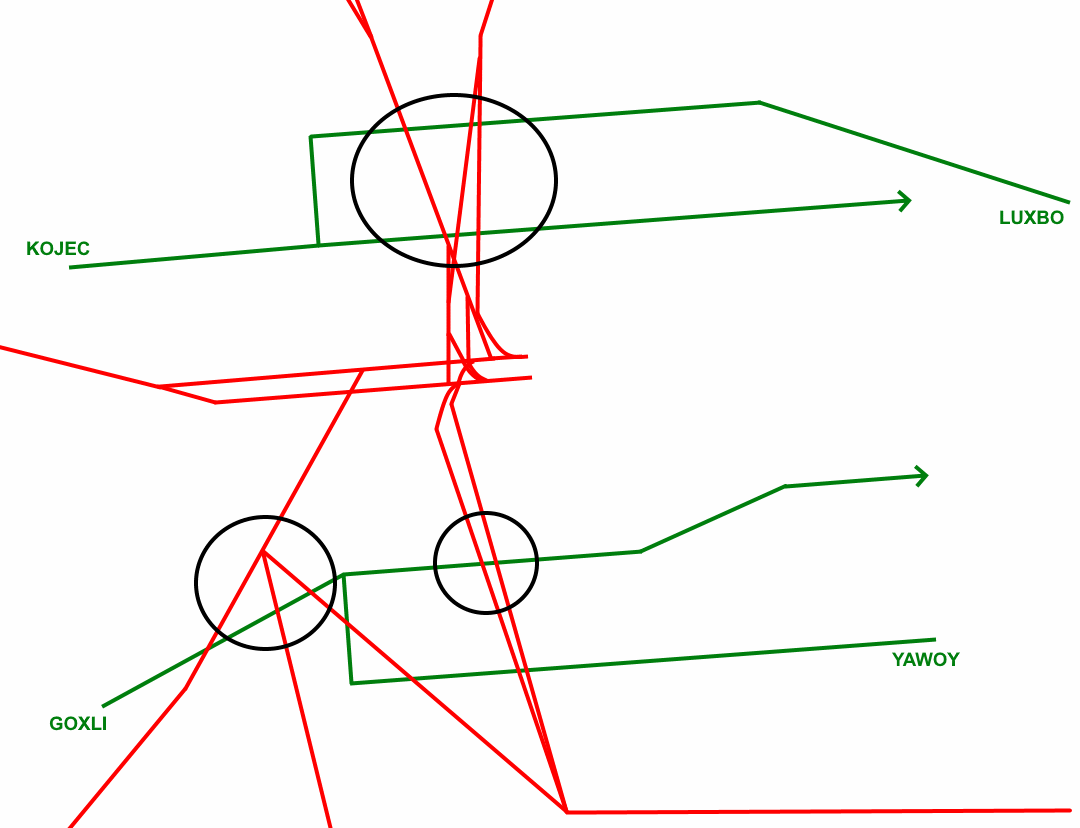 Approach paths and conflicts at 26 operations
As can be seen, STARs and SIDs intersect in most cases. It is therefore important to ensure that separation between departing and arriving traffic is maintained at all times. The following altitudes are recommended on the STARs:
| Position | Altitude |
| STAR Fix | FL110 |
| Upwind | FL100 |
| Downwind before mid-field | FL080 |
| Downwind after mid-field | 5000ft |
It is possible to deviate from these altitudes, but it is important not to clear any aircraft below FL080 before the conflict point between the SID and STAR has been passed.
After the aircraft have flown past the last waypoint of the STAR, the pilot is expected to maintain the downwind track. In this case, special attention must be paid to the MVA and the boundary to Berlin Approach, especially during 26 operations.
Transitions
Leipzig/Halle Airport has CDA transitions (Continuous Descent Approach), which are available from the waypoints MAXEB, UPLEG and LIPVO. These transitions may only be used between 22:00 and 06:00 local time. However, they are not commonly used.
Approach types
At Leipzig/Halle Airport, there are three published approach types for all runways. Leipzig has ILS, LOC, and RNP approaches. If a visual approach needs to be cleared, the approach controller is obliged to inform the Tower controller.
At night, the final approach must be at least at 11 NM for noise protection reasons (26: DP447/DP437, 08: DP442/DP432).
Operating mode
Independent parallel approaches are permitted in Leipzig. However, the primary operating mode is staggered. Every controller must familiarise themselves with the conditions of the respective operating mode in advance. Further information is available at the Tower-SOP. It is important to note that despite all conditions for IPA or staggered approaches, the MVA must be observed at all times!
Runway assignments
- Aircraft via KOJEC, LUXBO can expect the northern runway
- Aircraft via GOXLI, YAWOY can expect the southern runway
- Aircraft parked on aprons 1 and 3 can expect the northern runway
- If traffic conditions permit, cargo aircraft land on the southern runway
- Aircraft types A346/B77W/B744/B748/A388 should be assigned to the southern runway
Depending on the traffic situation, deviations from these specifications are possible. However, the Arrival controller determines the runway to be used by aircraft in all cases. During high-traffic operations, it is recommended to send more aircraft to the northern runway, as the southern runway is heavily congested with departures due to cargo traffic.
Handover to Leipzig Arrival
The handover to Leipzig Arrival normally takes place at a speed of 220 kts. If traffic conditions permit or require, aircraft may also be handed over at a higher or lower speed.
Traffic on the downwind leg is normally handed over as shown below:
| Downwind | RWY 08 | RWY 26 |
| North | 5000ft | 4000ft |
| South | 4000ft | 5000ft |
Individual direct approaches can also be coordinated with Leipzig Arrival.
Two Feeder Operations
Before opening the second arrival position, TRS, TRN and DPSD need to be staffed. The following procedures are necessary for two arrivals:
- Independent Parallel Approaches shall be used
- Independent Parallel Approaches need to fly an ILS approach or
- an RNP Approach with vertical guidance (LNAV-only is not authorized, this is described on the approach charts as well)
- Intercept headings need to be ≤ 30 degrees to the final approach track.
- 1 NM straight and level on the intercept heading,
- 2 NM straight and level on the final approach course
- Leipzig Arrival North (ND_APP) receives aircraft for the northern runway
- Leipzig Arrival South (SD_APP) receives aircraft for the southern runway
- TRS/TRN assign the runway, notify the pilot, and transfer aircraft to the appropriate Arrival station.
Application of RECAT-EU procedures
RECAT-EU separation can be applied at EDDP.
The use of RECAT-EU is only allowed for the category "Lower Heavy/Upper Heavy" and "Lower Heavy/Lower Heavy", specifically:
Upper Heavy |
Lower Heavy |
| A330 | A300 |
| A340 | A310 |
| A350 | B703 |
| B747 | B757 |
| B777 | B767 |
| B787 | B783 |
| IL96 | C135 |
| DC10 | |
| DC85 | |
| IL76 | |
| MD11 | |
| TU22 | |
| TU95 |
According to the procedure, 2 of the above aircraft types only have to be separated 3NM (wake turbulence) unless another method of separation (e.g. radar separation) requires more separation.
The pilot can refuse this procedure at any time, but shall inform you early.
Caution between Upper-Heavy and Lower-Heavy! The "Lower Heavy" must be preceding!
Mediums are excluded from this procedure!
Erfurt-Weimar
Aircraft are guided either via headings or the STAR. Clearance for the STAR is always given from Thüringen Süd Low. Here, particular attention must be paid to the convergence of traffic on the downwind and base legs. In addition, attention must be paid to VFR traffic, as the Erfurt TMZ area is very small and not every pilot is aware of the activity in this airspace. Furthermore, the MVA in Erfurt plays a not insignificant role. As soon as low visibility operations have to be used, approach direction 09 is no longer usable. Only the ILS on 27 up to CAT IIIb is permitted here.
Holzdorf
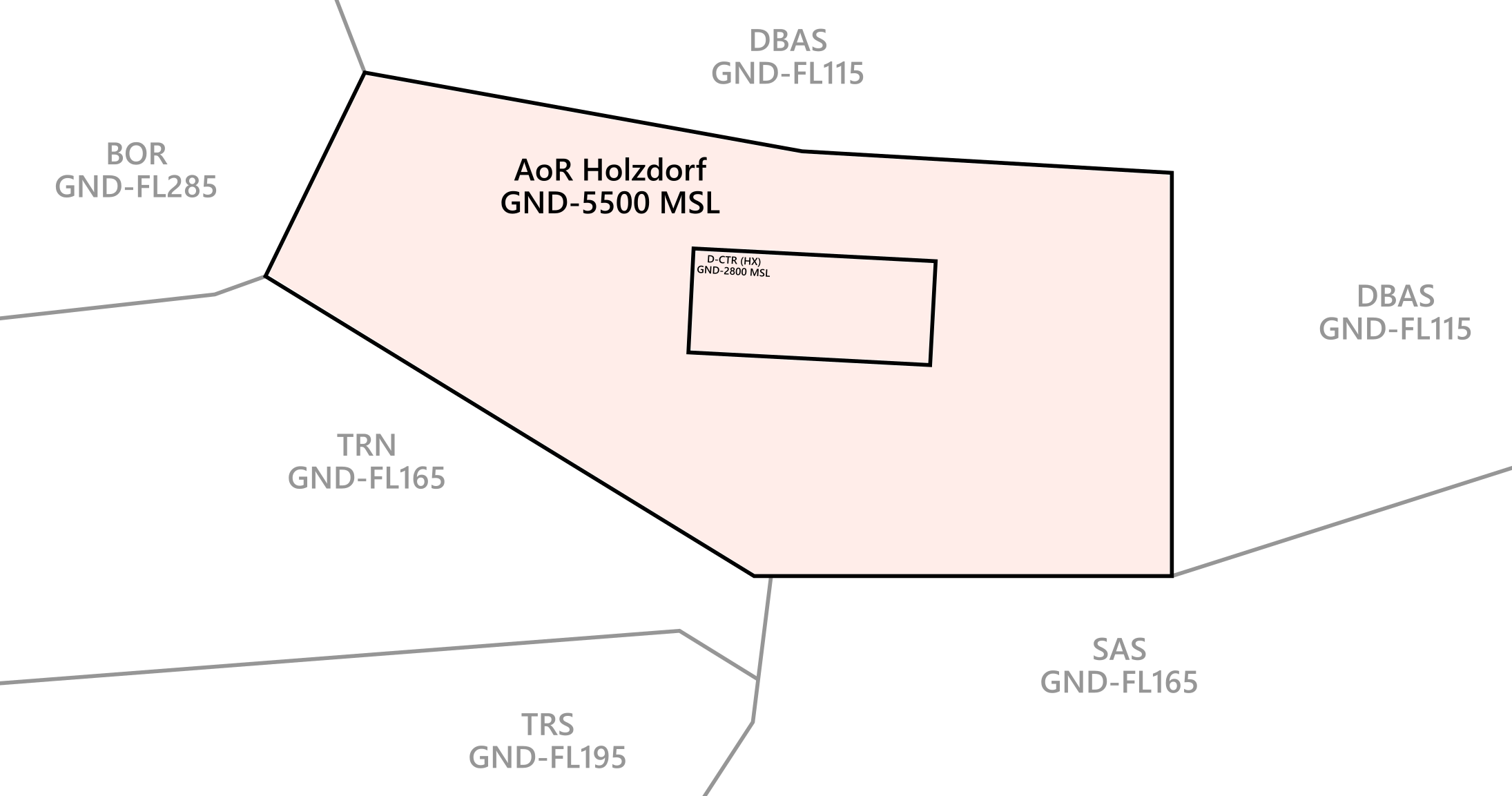
The Holzdorf military airfield has an area of responsibility in which Holzdorf Radar can control aircraft when activated. Berlin Arrival South is obliged to inform München Radar about the activation/deactivation of Holzdorf.
All aircraft to/from Holzdorf must be individually coordinated between Bremen Radar/München Radar and Holzdorf Radar.
Release Areas
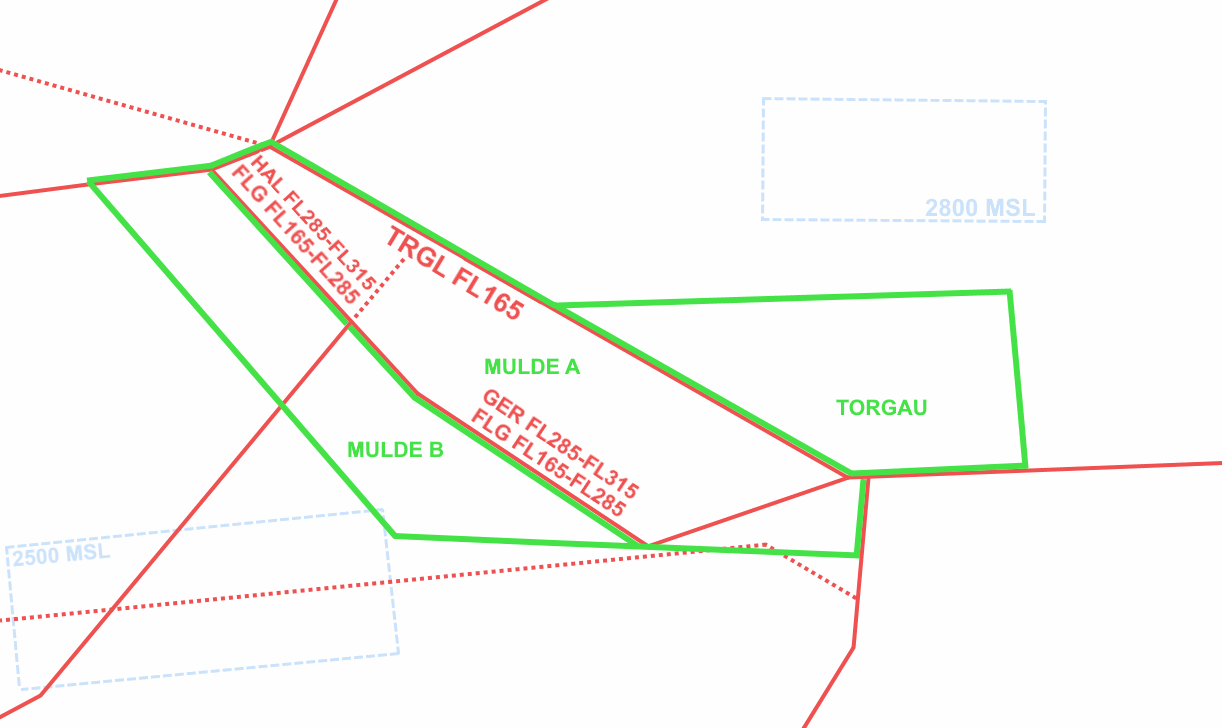
TORGAU Area
- GND - FL105 (Wenn Holzdorf AoR aktiv: 5500 MSL - FL105)
- Delegation von DBAS an TRN/S
- Only EDDP Inbound RWY 26
Activation only possible upon request from TRN/S by DBAS
MULDE A Area
- FL135 - FL165/FL195
- Delegation von TRN/S an ACC Sector FLG
- For EDDB TMA Inbounds (earlier descent possible)
Activation only possible upon request from ACC Sector FLG via TRN/S
MULDE B Area
- FL165 - FL195
- Delegation von TRN/S an ACC Sector FLG
- For EDDB TMA Inbounds (earlier descent possible)
Activation only possible upon request from ACC Sector FLG via TRN/S
 MULDE A,B Area, Torgau Area