
Tower
Lübeck Tower is responsible for all arriving and departing traffic. The top level of the airspace D control zone is 2000ft MSL. Above this altitude and around the CTR airspace E covers the area within responsibility of Bremen Radar (Hamburg Approach). South-East of the field is a nature reserve area (Schaalsee), which shall be avoided below 2000ft.
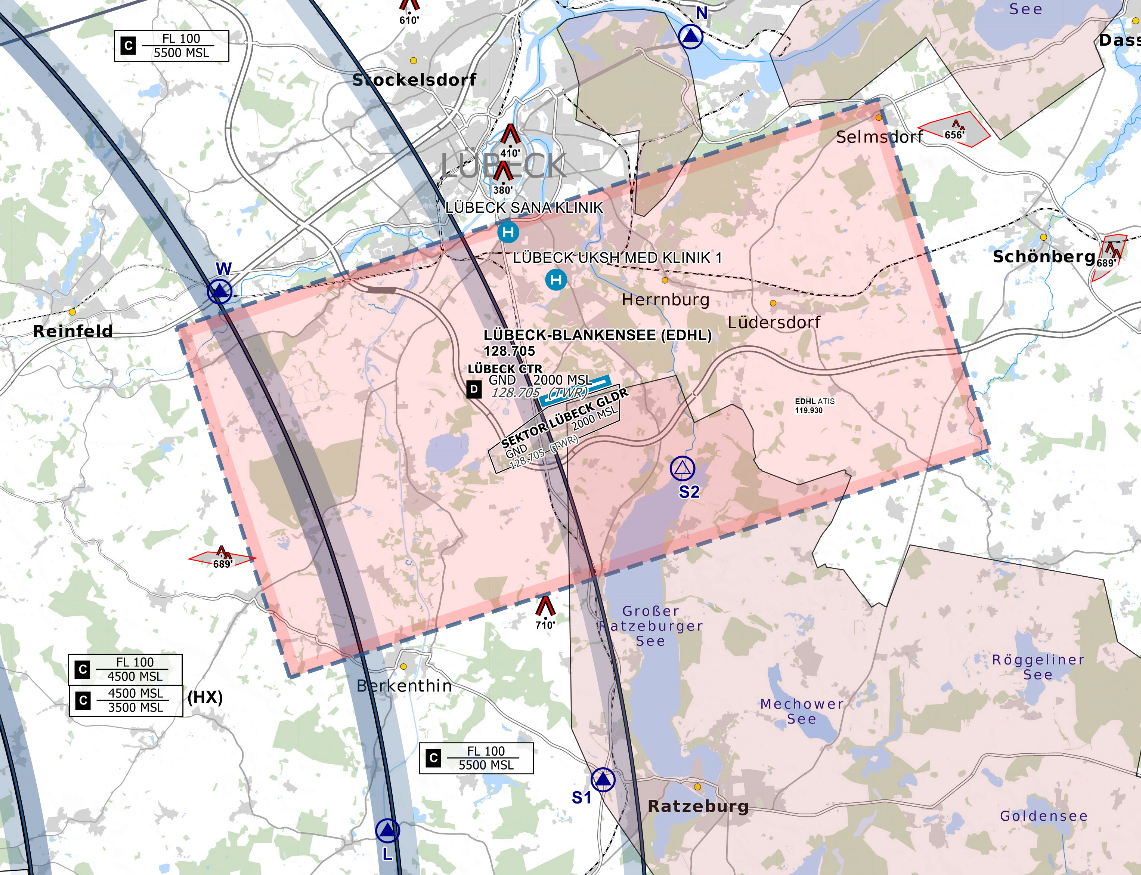
Controlzone and VFR Reporting Points of Lübeck Airport - © openflightmaps.org
Runway and Airport
Lübeck Airport has a 6896ft (2102m) long single runway (07 / 25) with Low-Visibility CAT II equipment on 07, as well as a grass glider strip south of the main runway. The runway configuration is not dependent on EDDH but should always be considered and coordinated with Bremen Radar (Hamburg Approach).
The Airport features a small terminal building with check-in facilities, a shop and some restaurants. The apron has three stands, which are suitable for Class C aircrafts such as the Airbus A320, as well as some stands for smaller general aviation aircraft.
Departures
All IFR Departures need a Departure-Release from Bremen Radar! *
Coordinate early enough on TeamSpeak, as Bremen Radar might restrict the initial climb clearance and departures times due to workload and traffic situation.
* If traffic permits, Radar can give a "general departure release until further notice". In that case the tower doesn't need to ask for each departure separately.
Spacing: Departures shall be separated with a minimum of 3 nm or wake turbulence separated, whichever is greater. When two aircrafts have the same SID waypoint the separation shall be increased to 5 nm or wake turbulence separation whichever is greater.
Auto-Handoff: Pilots shall contact Bremen Radar immediately after take-off without a specific handoff.
VFR
Lübeck Airport has four routes in and out of the CTR. Except S2, all other visual reporting points are mandatory.
| VRP | NOVEMBER | SIERRA (1+2) | LIMA | WHISKEY |
|---|---|---|---|---|
| NAV | Lübeck Harbor | Leading to Ratzeburg, west of the Ratzeburger Lake | Elbe-Lübeck Canal between Berkenthin and Mölln | Highway A1 west of Lübeck |
There are no distinct VFR procedures but it is common practice to use the two reporting points in active runway direction for departures and the two reporting points from behind the runway for arrivals.
Helicopters
Helipad: Lübeck Airport has no Helipads. Helicopters use the runway for all operations and can park at a designated parking area between Hangar E and G, north of the GA Apron. All Helicopters air-taxi to the runway.
Police and Rescue helicopters: Helicopter operations are likely in the vicinity of Hamburg and Lübeck City. Two medical Helicopter Pads are located north of the field inside the CTR.
Low Visibility Procedures (LVP)
Low Visibility Procedures will be applied when:
- RVR ≤ 600 m or ceiling/vertical visibility < 200 ft
EDHL is approved up to CAT II for runway 07 with a minimum RVR of 300 m. Additionally, Low Visibility Takeoffs (LVTO) are approved from RWY 07 if the RVR is ≥ 300 m. RWY 25 is not approved for LVO.
Whenever low visibility conditions exist, runway 07 should be used as the runway in use. Wind conditions shall be disregarded.
Lübeck Tower shall inform GND and APP about the beginning and termination of LVP.
Further general information is available here.
Taxi Procedures
During LVO, only TWY A shall be used for takeoff and landing. TWYs B and C will be closed.
Landing traffic shall be instructed to backtrack RWY 07 and vacate via A. Close coordination with GND is required to avoid nose-to-nose situations.
ATIS and Ground Radar
ATIS Setup
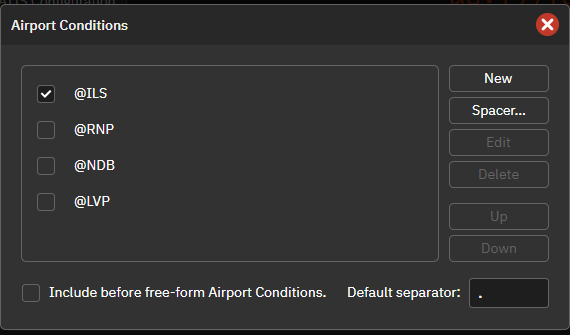
Whenever LVO conditions exist, it shall be broadcast in the ATIS.
The following shall be announced whenever Low Visibility Conditions are in effect:
- LOW-VISIBILITY PROCEDURES IN OPERATION, CAT II AVAILABLE
This can be selected in the vATIS airport conditions dialogue.
Ground Radar Setup
The Tower controller shall activate the "LVP" mode of the Groundradar Plugin. This activates LVO safety buffers and displays the CAT II/II holding points. Additionally, the position of the localiser will be displayed.

Separation
Whenever the LVP separation minima is not met, a Go Around should be instructed.
Arrivals to Arrivals
During LVO, the preceding arriving aircraft must cross the CAT II/III holding point before the succeeding aircraft passes 2 NM final.
Departures to Departures
Between two departing aircraft, full runway separation shall be applied. The use of RRS is prohibited.
Departures to Arrivals
To avoid interference with the ILS signals, the preceding departing aircraft needs to be clear of:
- The critical area before any succeeding aircraft reaches a 4 NM final,
- The sensitive area before any succeeding aircraft reaches a 2 NM final.
Full runway separation needs to be applied. The use of RRS is prohibited.
For simplicity, the critical area is defined by the runway area starting at the CAT I holding points, whereas the sensitive area is considered as the runway area defined by the CAT II/III holding points.