
Tower
Kassel Tower is responsible for all arriving and departing traffic. The top level of the airspace D control zone is 2700ft MSL. Above this altitude and around the CTR airspace E covers the area within responsibility of Bremen Radar. A Para jumping Area up to FL100 is directly above the airport.
 Controlzone of Kassel Airport - © openflightmaps.org
Runway and Airport
Kassel Airport has a 8200ft (2500m) long single runway (09 / 27) with a CAT IIIa/b Low-Visibility equipment available at runway 27. The airport features two aprons, one in front of the passenger terminal for two mid-sized aircraft such as the Airbus A320 family and a separate one for general aviation aircraft.
Departures
All IFR Departures need a Departure-Release from Bremen Radar! *
Coordinate early enough on TeamSpeak, as Bremen Radar might restrict the initial climb clearance and departures times due to workload and traffic situation.
* If traffic permits, Radar can give a "general departure release until further notice". In that case the tower doesn't need to ask for each departure separately.
Spacing: Departures shall be separated with a minimum of 3 nm or wake turbulence separated, whichever is greater. When two aircrafts have the same SID waypoint (e.g. WRB) the separation shall be increased to 5 nm or wake turbulence separation whichever is greater.
Auto-Handoff: Pilots shall remain on TWR frequency until passing 2500ft and then contact Bremen Radar without a specific handoff. Below 2000ft Radar might not understand the pilot due to interferences with the surrounding topography.
Arrivals
Arrivals shall be instructed to contact Ground when they are vacating while rolling on L.
Reduced Runway Separation (RRS): Reduced Runway Separation can be applied for aircraft of category 1 and 2.
VFR
Kassel offers four routes in and out of the CTR with two published holding patterns in the north and south of the field. Only the outer Waypoints are mandatory reporting points.
| VRP | N1 | E1 | W1 | S1 |
|---|---|---|---|---|
| NAV | Federal Road junction west of Hofgeismar | Reinhards Forest, Federal Road junction | West of Oberelsungen close to the Highway A44 | Fuldatal east of Kassel |
Helicopters
Helipad: Kassel Airport has one Helipad on Taxiway L at Apron Entry E3 which can be used for arriving and departing helicopters. Tower shall coordinate with Ground to achieve spacing between arriving or departing helicopters and taxing traffic, since the helipad is on the taxiway.
Police and Rescue helicopters: Helicopter operations are likely in the vicinity of Kassel City. An important hospital is located north of the field in Hofgeismar which makes CTR crossings necessary. Christoph 7 (CHX7) is located at the Rotes Kreuz Krankenhaus Kassel, south east of the field.
Low Visibility Procedures (LVP)
Low Visibility Procedures will be applied when:
- RVR ≤ 600 m or ceiling/vertical visibility < 200 ft
EDVK is approved up to CAT III for runway 27 with a minimum RVR of 75 m. Additionally, Low Visibility Takeoffs (LVTO) are approved for RWY 09 and RWY 27. Landings on RWY 09 during LVO are not allowed.
During LVP, the preferred RWY is 27 and should be offered even if tailwind exists. RWY 09 can be used for takeoff if weather conditions allow, but not for landings.
Kassel Tower shall inform GND and CTR about the beginning and termination of LVP.
Further general information is available here.
ATIS and Ground Radar
ATIS Setup
Whenever LVO conditions exist, it shall be broadcast in the ATIS.
The following shall be announced whenever Low Visibility Conditions are in effect:
- LOW-VISIBILITY PROCEDURES IN OPERATION, CAT II AND III AVAILABLE
In case only LVTO on RWY 09 is used, the following shall be announced:
- LOW VISIBILITY TAKE-OFF PROCEDURES RUNWAY 09 IN OPERATION
This can be selected in the vATIS airport conditions dialogue.
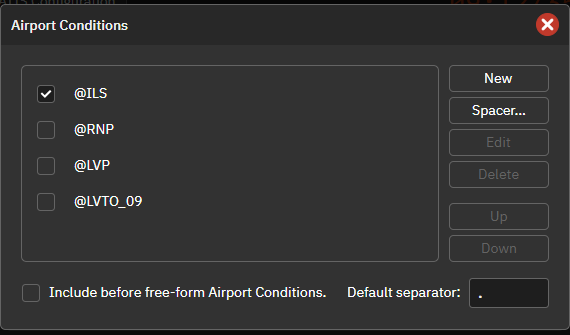
Alternatively, &lvp can be used when using the uniatis ATIS link.
Ground Radar Setup
The Tower controller shall activate the "LVP" mode of the Groundradar Plugin. This activates LVO safety buffers and displays the CAT II/II holding points. Additionally, the position of the localiser will be displayed.

Separation
Whenever the LVP separation minima is not met, a Go Around should be instructed.
Arrivals to Arrivals
During LVO, the preceding arriving aircraft must cross the CAT II/III holding point before the succeeding aircraft passes 2 NM final.
Departures to Departures
Between two departing aircraft, full runway separation shall be applied. The use of RRS is prohibited.
Departures to Arrivals
To avoid interference with the ILS signals, the preceding departing aircraft needs to be clear of:
- The critical area before any succeeding aircraft reaches a 4 NM final,
- The sensitive area before any succeeding aircraft reaches a 2 NM final.
Full runway separation needs to be applied. The use of RRS is prohibited.
For simplicity, the critical area is defined by the runway area starting at the CAT I holding points, whereas the sensitive area is considered as the runway area defined by the CAT II/III holding points.
In case of a preceding arriving aircraft, the succeeding departing aircraft may commence its take-off roll once the arriving aircraft has crossed the CAT II/III holding point.